



Water Line Replacement Cost: What Homeowners Should Expect to Pay
When water pressure drops, soggy spots appear in the yard, or the utility bill climbs for no clear reason, the main line feeding your home may be failing. Knowing the typical water line replacement cost before you call a plumber helps you budget, compare quotes, and avoid paying for a bigger project than your home actually needs.
Prices vary widely because every property is different. Pipe material, the distance from the meter to the house, the installation method, soil conditions, and permit requirements all change the final number. At Schneider Plumbing, Heating & Air Conditioning, we help homeowners sort through those variables on every water line project, from the first inspection through final backfill.
Water Line Replacement Cost: What Homeowners Typically Pay
Replacing a main water line is a major project, but it is often necessary for older homes and for properties with chronic plumbing trouble. Most homeowners land somewhere between roughly $2,000 and $6,000 for a full replacement. Short, simple runs can come in closer to $1,500 to $3,000, while long or complicated installations can climb past $10,000.
The table below shows how the total typically changes with the length of the line from the water meter to your house.
| Line Length | Typical Total Cost | What Usually Applies |
|---|---|---|
| Short run (under 50 feet) | $1,500 to $3,000 | Minimal digging, quick turnaround |
| Medium run (50 to 100 feet) | $3,000 to $6,000 | More labor, longer trench or bore path |
| Long run (100+ feet) | $6,000 to $10,000 or more | Added materials, equipment, and restoration |
These are typical contractor ranges, and your written estimate will reflect your property. Concrete, mature landscaping, and tight access can all push a project toward the higher end.
Water Line Replacement Cost by Pipe Material
The pipe you choose has a direct effect on both the material bill and how long the new line will last. These figures cover the pipe itself, not labor, digging, or restoration.
| Material | Pipe Cost per Linear Foot | Commonly Cited Lifespan | Best Fit |
|---|---|---|---|
| Copper | $10 to $20 | 50 to 75 years | Longevity and corrosion resistance |
| PEX | $2 to $5 | 40 to 50 years | Flexible runs and freeze-thaw cycles |
| PVC | $3 to $8 | 25 to 40 years | Budget-friendly, shorter runs |
Lifespans depend on water chemistry, soil, and installation quality, so treat them as general guidance rather than guarantees. Copper costs the most per foot but resists corrosion for decades. PEX is flexible, fast to install, and handles ground movement well. PVC keeps the material bill low, which helps on shorter runs where the budget matters most.
If your home still has a galvanized steel line, the conversation changes. Those older pipes corrode from the inside, restrict flow, and can affect water quality. When a home has aging supply piping throughout, whole-home re-piping can be a smarter investment than replacing one section at a time.
What Drives the Final Price of a New Water Line
Material is only one piece of the estimate. Method, distance, permits, soil, and surface restoration often matter just as much. Here is how each one moves the total.
Trenchless vs Open-Cut Water Line Replacement Cost
One of the biggest cost differences comes from how the new line gets installed. Trenchless and open-cut replacement both work, but they affect your yard, your schedule, and your budget in different ways.
Traditional Open-Cut Replacement
Open-cut replacement means digging a trench from the house to the street, pulling out the old line, and laying the new pipe. It is reliable and works in nearly every situation, including collapsed or badly corroded lines. The trade-off is disruption to landscaping, walkways, and driveways.
Contractor pricing for the trenching and pipe work commonly runs $50 to $250 per linear foot, and surface restoration is a separate cost that many homeowners overlook. Expect the job to take a few days from start to finish.
Trenchless Replacement
Trenchless methods use small entry and exit pits instead of one long trench. With pipe bursting, a new line is pulled through the path of the old one as the old pipe is fractured and pushed aside. Other trenchless approaches pull a flexible new line through a bored path.
Trenchless replacement typically runs about $75 to $150 per linear foot. Because it limits digging and restoration, it can come out ahead of open-cut on the final invoice, especially when the line crosses a driveway, patio, or established landscaping. It is not always possible, though. If the old line has collapsed or the ground is unstable, open-cut may be the only workable option.
Pipe lining, where a resin liner is cured inside an existing pipe, is used less often for pressurized household water lines than for sewer lines. Ask your plumber whether it is even a realistic option for your pipe before it appears on a quote.
Distance From the Water Meter
Labor, materials, and excavation time all grow with the length of the line. A home set far back from the street costs more to connect than one a short distance from the meter. Lines that pass under concrete, mature trees, or finished landscaping also take longer and add restoration work.
Permits, Inspections, and Utility Locates
Every replacement has to meet local code. Before digging starts, your plumber pulls the required permits and arranges utility locates so buried gas, electric, and communication lines are marked. In most of the country, that locate request goes through the national Call 811 service, and it should always happen before any excavation.
Permit fees vary by municipality, often from around $50 to a few hundred dollars. A final inspection confirms the work meets code. A reputable contractor handles this paperwork, because skipping permits can lead to fines, delays, and trouble when you sell the home.
Soil, Frost Depth, and Surface Restoration
Rocky or compacted soil takes longer to excavate, and a high water table can complicate trenching. In colder climates, lines must be buried below the frost line, which means deeper digging. Restoration rounds out the project: backfilling, compacting, and repairing lawns, concrete, or asphalt all belong in your estimate, and they are a common source of surprise charges when left off a quote.
Lead and Galvanized Water Lines: When Replacement Is a Safety Decision
Sometimes the reason to replace a line has nothing to do with leaks. Older homes may be served by galvanized steel or lead pipe, and both can affect water quality. The EPA states that lead service lines are among the most common sources of lead in drinking water, and federal rules now direct water systems to inventory their service lines and replace lead lines on a multi-year schedule.
The EPA’s latest national estimate is about 4 million lead service lines, down from an earlier estimate of roughly 9 million as utilities reported better inventory data.
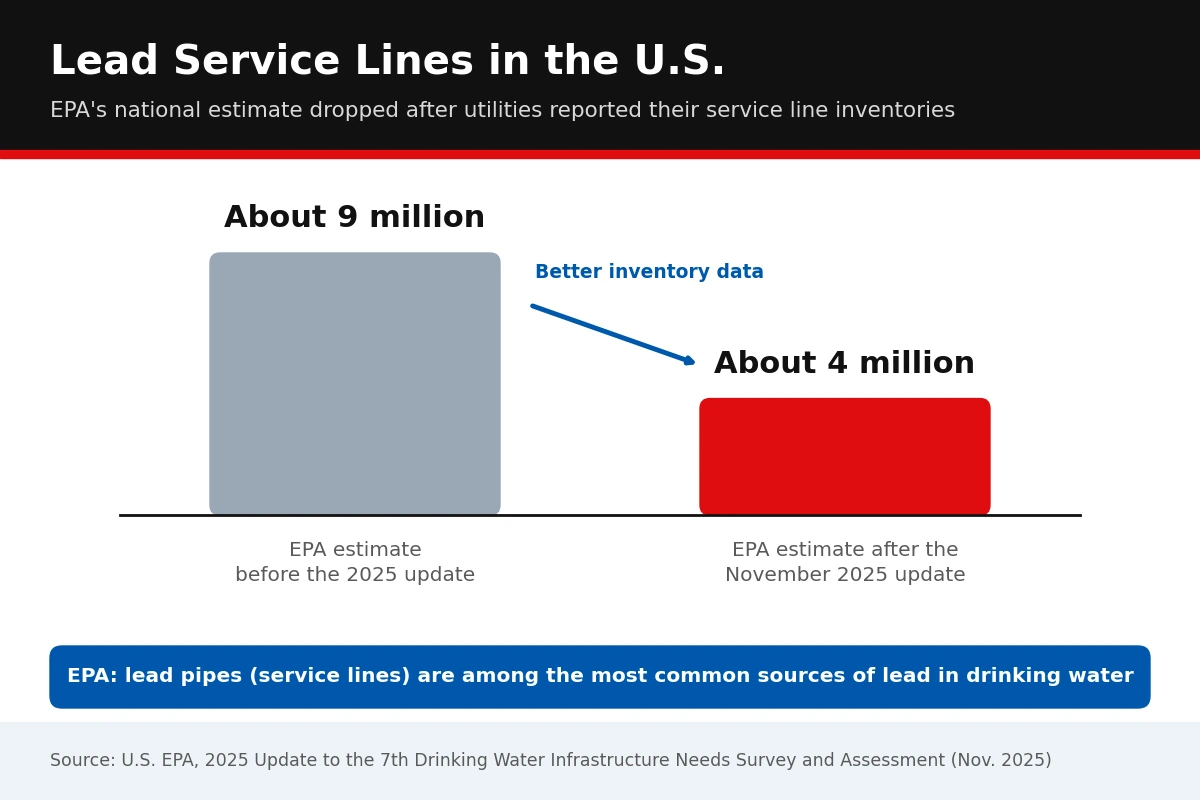
Source: U.S. EPA, 2025 Update to the 7th Drinking Water Infrastructure Needs Survey and Assessment
How to Check What Your Water Line Is Made Of
Start where the line enters your home, usually near the water meter or main shutoff. A few simple clues help, though a plumber or your water utility should confirm the material:
- Copper: reddish-brown, like a penny, and a magnet will not stick to it.
- Galvanized steel: dull gray, and a magnet sticks to it.
- Lead: soft, dull gray metal that turns shiny silver when lightly scratched with a coin, and a magnet will not stick to it.
Water utilities are required to keep service line material inventories, so your utility may already have your address on record. If your home was built before 1986, it is worth asking.
Who Pays to Replace a Lead or Galvanized Line?
Ownership usually splits at the meter or curb stop. The utility typically owns the section on the street side, and the homeowner owns the section from there to the house, though this varies by community. Federal funding has been flowing to states for lead line replacement, so ask your water utility whether a local program covers all or part of the private-side cost before you sign a contract.
Repair vs Replacement: How to Make the Call
When a leak or pressure problem shows up, the first question is whether a repair will do. Sometimes it will. Other times, patching an aging line just buys a few months before the next failure.
Warning Signs of a Failing Water Line
- Sudden drops in water pressure: often a hidden leak or a partial blockage in the line.
- Discolored or rusty water: a sign of corrosion or sediment inside aging pipe.
- Persistent wet spots or sinkholes in the yard: a buried leak can saturate the soil above it.
- Unexplained jumps in your water bill: even a small leak can waste hundreds of gallons a day.
- A water meter that keeps moving when everything is off: a classic indicator of a leak somewhere on your side of the meter.
- Repeated repairs on the same line: frequent fixes usually mean the pipe itself is failing.
The numbers behind hidden leaks are larger than most homeowners expect. According to the EPA’s WaterSense program, the average household’s leaks waste more than 10,000 gallons a year, and about 10 percent of homes have leaks that waste 90 gallons or more per day.
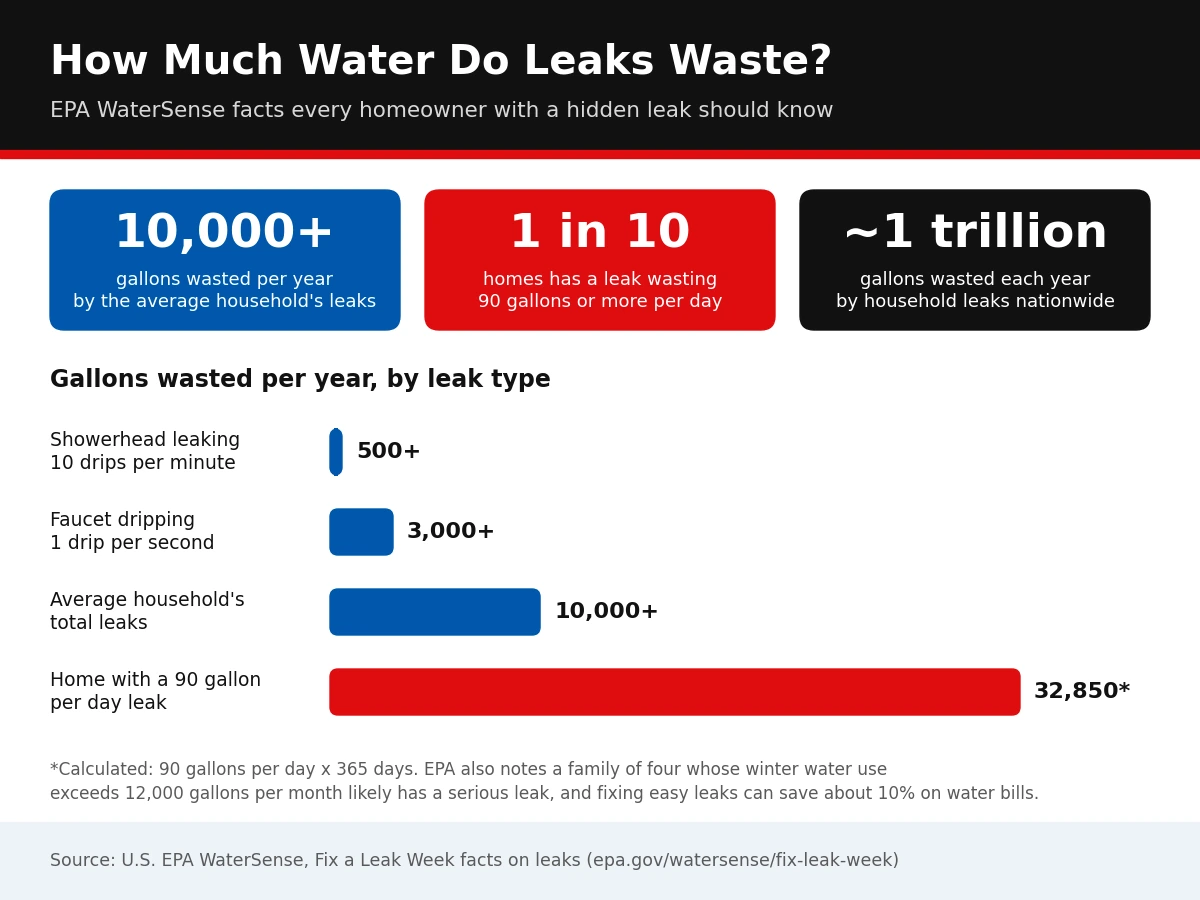
Source: U.S. EPA WaterSense, Fix a Leak Week
The EPA also notes that a family of four whose winter water use tops 12,000 gallons per month likely has a serious leak. If your bill or meter points that way, professional leak detection can pinpoint the source with a camera inspection or pressure test, so you know whether you are dealing with a small repair or a failing line.
Repair Costs Compared With Replacement
A small repair on a water line commonly runs $300 to $1,500, depending on depth, access, and what has to be dug up to reach the damage. That can be the right call when the pipe is otherwise sound and the leak is isolated to one spot.
When the line is old, corroded, or made of a failing material like galvanized steel, replacement is usually the more economical choice over time. Each repair leaves the rest of the pipe in the same condition, and repeated service calls and excavation add up quickly. For isolated damage on otherwise healthy piping, targeted pipe repair remains a sensible, lower-cost option.
Long-Term Benefits of a New Water Line
Replacement costs more up front, but it solves the underlying problem instead of the latest symptom:
- Cleaner water: new pipe reduces rust, sediment, and lead or corrosion concerns.
- Better water pressure: a clear, full-diameter line restores steady flow throughout the house.
- Fewer emergency calls: you stop paying to repair the same failing pipe again and again.
- Stronger resale appeal: buyers and inspectors favor updated plumbing.
- Long service life: a properly installed modern line can last 50 years or more.
How to Compare Water Line Replacement Quotes
Two quotes for the same job can look very different if one leaves out restoration or permits. Comparing them fairly starts with knowing what a complete estimate includes.
What a Complete Estimate Should Include
- The length of the line, pipe material, and pipe diameter
- The installation method (trenchless or open-cut) and the reason for it
- Permit fees, inspection costs, and who handles utility locates
- Surface restoration for lawns, concrete, asphalt, or landscaping
- Expected timeline and how long your water will be shut off
- Labor and material warranty terms in writing
Questions to Ask Before You Hire
Ask whether the contractor is licensed and insured, who pulls the permit, and what happens if they hit unexpected rock or an unmarked line. Ask for a camera inspection or pressure test result so the scope is based on the actual condition of the pipe. Warranties vary by product and contractor, so get both the labor and material coverage in writing, and ask whether financing is available if the project is larger than planned. An experienced licensed plumbing contractor will answer these questions without hesitation and put the scope in writing.
Water Line Replacement Cost FAQs
How much does water line replacement cost?
How much does it cost to replace a main water line from the meter to the house?
Is trenchless water line replacement cheaper than digging a trench?
How long does a water line replacement take?
Does homeowners insurance cover water line replacement?
Who is responsible for the water line, the homeowner or the city?
How do I know if my water line needs to be replaced?
Plan Your Water Line Replacement With Confidence
A failing water line rarely fixes itself, and small leaks tend to become expensive problems. Once you understand how material, method, distance, permits, and restoration shape the price, you can compare quotes with confidence and choose the approach that fits your home and budget.
Schneider has been family-owned since 1948, and we treat every home as if it were our own. Whether you need an honest opinion on a leak, a camera inspection, or a full replacement estimate, schedule a water line inspection with our team and we will walk you through your options.