The Schneider Team represents the licensed plumbers and HVAC technicians at Schneider Plumbing, Heating and Air Conditioning, a family-owned business serving Seymour, Indiana since 1948. Founded by Louis Schneider and now run by the third generation of the family, our team combines decades of field experience with a straightforward approach to service. We write to help homeowners understand their systems, spot problems early, and know when it's time to call a professional.
A furnace burning smell during the first cold snap of the year is almost always harmless. When a furnace fires up for the first time after sitting idle all summer, it burns off the dust and debris that settled on the heating element, and that smell travels straight through the vents. It is unpleasant, but it is not dangerous. The problem is that two or three other furnace odors look identical on the surface and are genuinely hazardous. Knowing the difference is not complicated once you understand what each smell represents.
What Causes a Furnace Burning Smell?
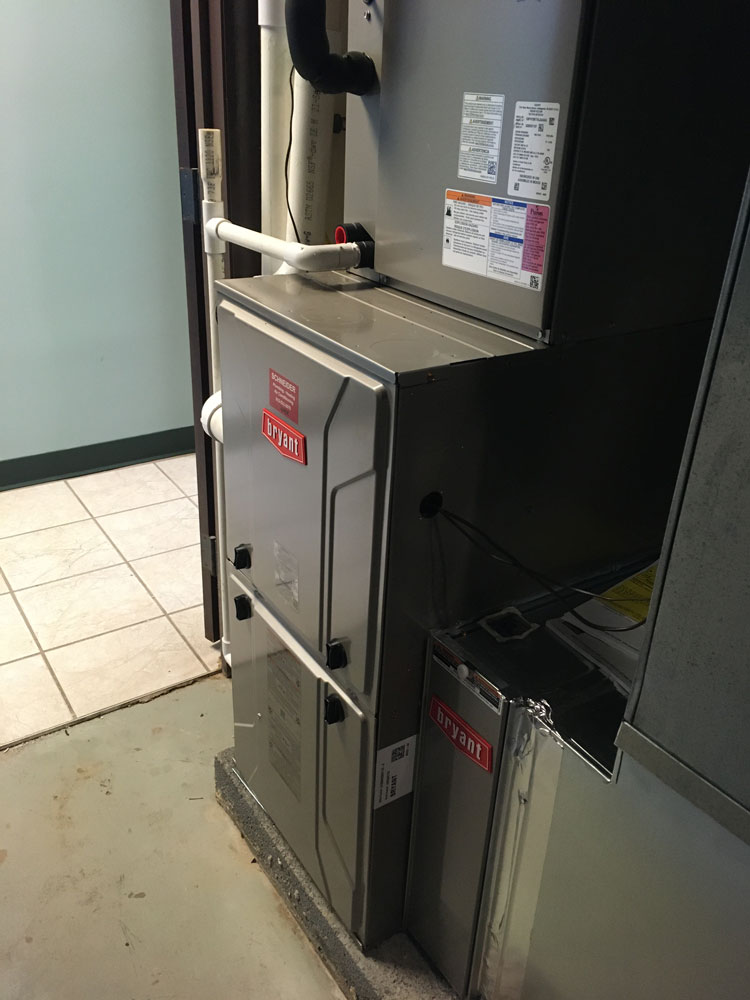
The most common cause, by a wide margin, is seasonal dust burning off the heat exchanger, the metal chamber that heats the air moving through the home. Think about what happens to a lamp that has not been switched on in months: a thin film of dust coats the bulb, and the moment the switch flips, that dust scorches and fills the room with a faint, acrid smell. A furnace works the same way. During the off-season, household dust, pet dander, and pollen settle directly onto the heat exchanger. When the furnace runs its first cycle of the season, that layer burns off and the smell moves through every duct in the house. It clears on its own, usually within 20 to 30 minutes of continuous operation.
How Long a Furnace Burning Smell Should Last
A genuine dust burn-off smell should clear within 20 to 30 minutes of continuous operation. Opening a window or two speeds that along by giving the odor somewhere to go. If the smell is still present after the furnace has completed two or three full heating cycles, it has moved past the category of normal startup behavior and is worth a closer look.
A clogged air filter creates a different but related problem. When the filter is packed with debris, airflow through the furnace drops sharply. The blower motor, the fan that pushes warm air through the home, strains to push air through the restriction, and the internal chamber heats beyond its normal operating range. The result is a hot, dusty, faintly metallic odor that does not smell quite like clean dust burn-off. A filter change is often the first and only fix needed, and it takes less than five minutes.
Burning plastic or a sharp chemical odor is a different category entirely. The blower motor sits inside a plastic housing, and when that motor runs too hot, whether from age, a failing bearing, or restricted airflow, the housing can begin to warp and melt. It is similar to leaving a plastic container too close to a hot stove burner: the material does not burst into flames immediately, but it softens, deforms, and releases a harsh chemical smell that no amount of ventilation will clear on its own. That odor means something is actively breaking down inside the furnace.
Oil-fired furnaces introduce one more variable. A clogged burner nozzle or a delayed ignition issue can produce a heavy, sooty oil smell that lingers well past startup. More critically, any fuel-burning appliance, gas, propane, or oil, can produce carbon monoxide when combustion is incomplete. Carbon monoxide has no smell, no color, and no taste, which is exactly why understanding the other odors a furnace produces matters so much.
When a Furnace Smell Signals Danger
Dust burn-off smells dry and organic, like something old being heated rather than something synthetic melting. It fades. Dangerous odors do not fade. They either hold steady or intensify as the furnace continues to run. That persistence is the most reliable field test available.
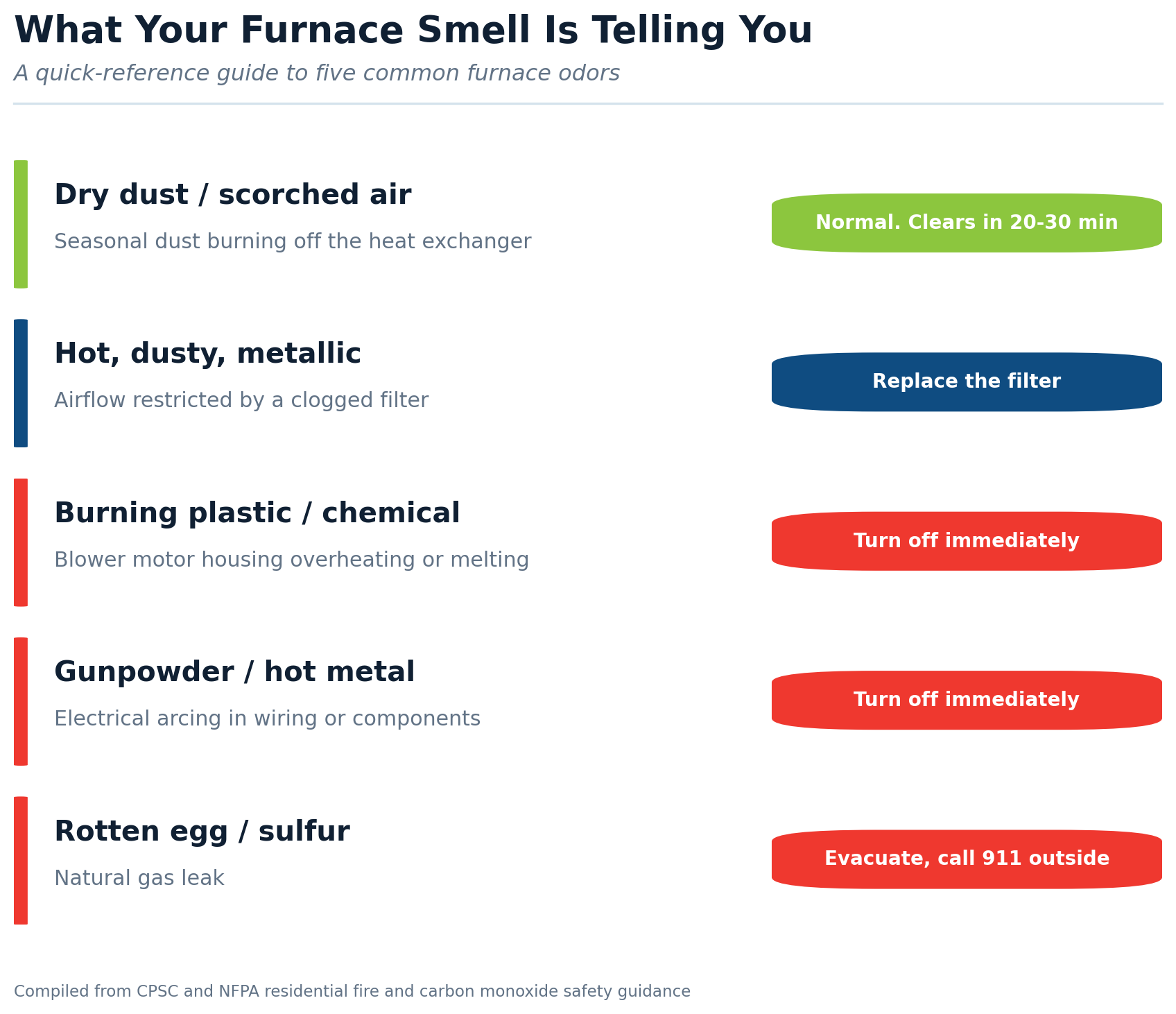
A quick reference for what each smell signals:
Dry dust or scorched air: Normal seasonal burn-off, clears within 30 minutes, no action required beyond ventilating the space
Burning plastic or acrid chemical odor: Melting blower motor housing or wire insulation, does not clear, turn the furnace off immediately
Gunpowder, hot metal, or ozone: Electrical arcing from shorted or damaged wiring, turn the furnace off immediately and do not restart it
Rotten egg or sulfur: Natural gas leak, do not touch any switches, evacuate the house and call 911 from outside
Heavy oil or sooty fuel smell: Clogged burner nozzle or delayed ignition on an oil-fired system, worth getting checked out before running the furnace further
The Real Risk Behind These Odors: Fire and Carbon Monoxide
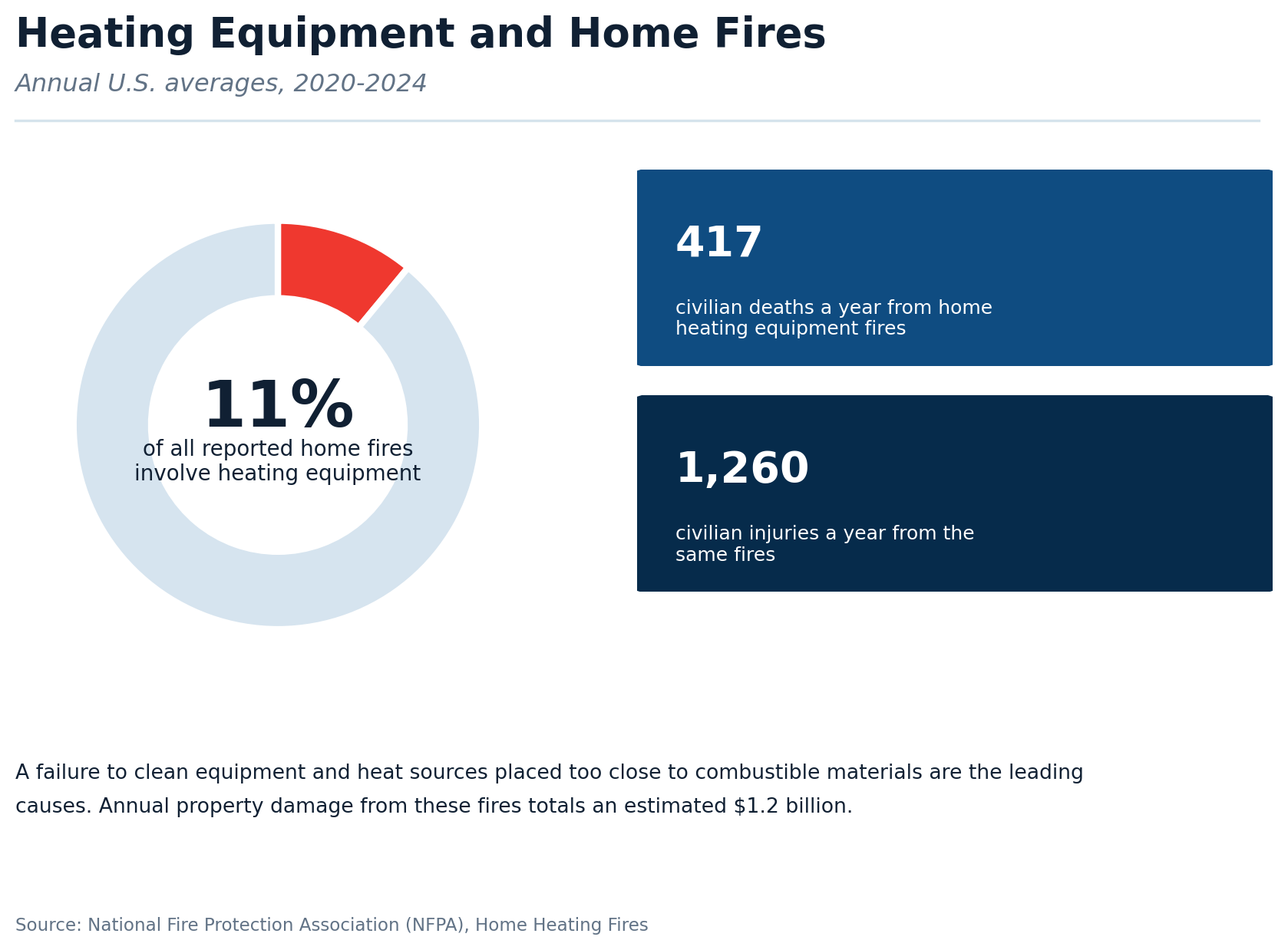
Heating equipment is a leading cause of home fires, and the numbers make a strong case for taking a persistent burning smell seriously rather than waiting it out.
According to the National Fire Protection Association, heating equipment accounts for an estimated 11 percent of all reported home fires each year, resulting in an average of 417 civilian deaths, 1,260 injuries, and $1.2 billion in property damage annually. A failure to clean equipment, exactly the kind of buildup that produces that seasonal dust smell if it is never addressed, is among the leading causes.
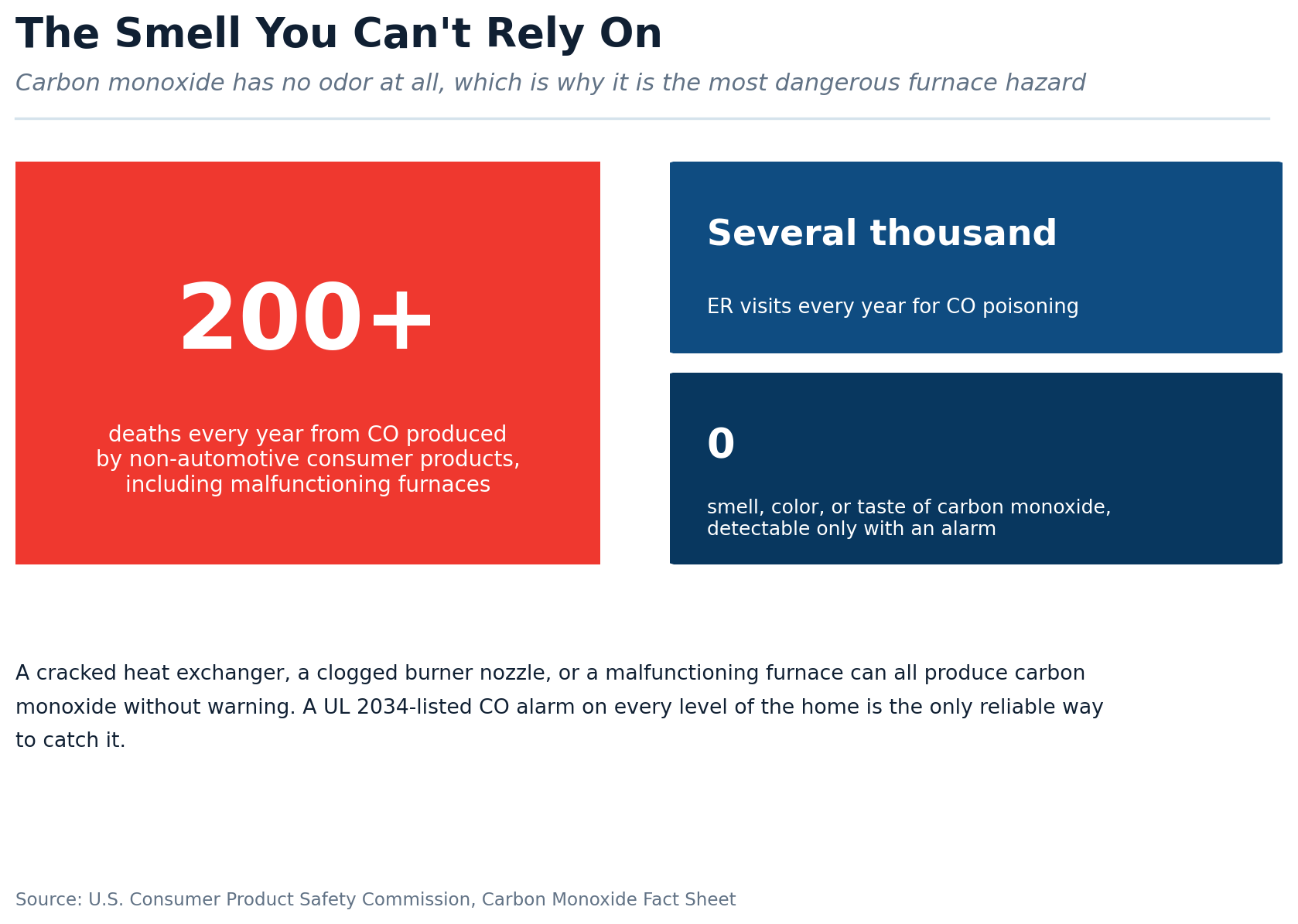
Carbon monoxide is the second and more insidious risk. A cracked heat exchanger is like a crack in a car’s engine block. It means the system is not working safely and needs attention right away. A crack in the component that heats a home’s air allows combustion gases, including carbon monoxide, to mix with the air circulating through the house. Because CO is colorless and odorless, it cannot be detected by smell under any circumstances.
According to the Consumer Product Safety Commission, more than 200 people in the United States die every year from carbon monoxide produced by non-automotive consumer products, including malfunctioning furnaces, and several thousand more are treated in emergency rooms for CO poisoning annually.
The only reliable protection is a UL 2034-compliant carbon monoxide alarm installed on every level of a home and outside sleeping areas. If a CO alarm sounds, treat it as an emergency: move everyone outside immediately and call 911.
Electrical, Motor, and Belt Problems That Create Burning Odors
When the smell is not dust, the source is almost always somewhere in the furnace’s mechanical or electrical components, and these problems do not resolve on their own.
An overheating blower motor is one of the more common culprits. The blower motor is essentially the fan that pushes warm air through the home, and when it fails, the heat cannot reach the rooms it is meant to serve. When its bearings wear down or lose lubrication, the motor runs hot, and friction creates intense heat. The smell it produces is metallic and oily, closer to a burning machine than burning dust. Left unaddressed, an overheating motor will eventually seize completely, leaving the house cold and adding a motor replacement to the repair bill.
Older furnace models use a rubber belt to connect the motor shaft to the blower fan. That belt can slip, crack, or friction-heat as it ages, and the smell it produces is unmistakably burning rubber, distinct from both dust and electrical odors. Replacing a worn belt is a simple, low-cost repair. The risk is letting it go until the belt snaps and the blower stops moving air entirely.
Damaged or loose electrical wiring produces a sharp, pungent smell that most people describe as gunpowder or hot metal. Electrical arcing, where current jumps across a gap in damaged insulation, generates intense localized heat, and that heat is what produces the smell. It can trip a circuit breaker, and if the arc finds combustible material nearby, it becomes a fire hazard quickly.
Signs the Heating System Should Be Turned Off Immediately
Turn a furnace off at the thermostat, and then at the circuit breaker, if any of the following are present:
A chemical or plastic odor that does not fade within 30 minutes of startup
A gunpowder or hot-metal smell, which signals electrical arcing in the wiring or components
A rotten egg or sulfur smell, which is a natural gas odorant. Leave the house without touching any light switches or electrical devices, then call 911 from outside
A circuit breaker that trips every time the furnace cycles on
Visible scorch marks or discoloration around the furnace cabinet or electrical panel
A burner flame that burns yellow or orange instead of a steady blue
Any of these, combined with a burning odor, means the furnace should stay off until a technician has inspected it. A malfunctioning appliance identified as a carbon monoxide source should not be operated again until it has been properly serviced by trained personnel.
What to Check Before Calling for Furnace Repair
Before calling a technician, a few basic checks can rule out the simplest causes and give a technician useful information if a service call does turn out to be necessary.
Start with the air filter. Pull it out and hold it up to the light. If it is gray, matted, or covered in pet hair, it is blocking airflow enough to cause the furnace to overheat and smell like it is burning. Replace it with a clean filter before running the furnace again. This single step resolves a surprising number of burning odor complaints and costs a few dollars.
Next, walk around the sides of the furnace itself. Cardboard boxes, plastic storage bins, cleaning chemicals, and anything else stored within three feet of the unit can heat up and begin to off-gas when the furnace runs. Clear that space completely. Furnaces generate significant heat, and the three-foot clearance rule exists for good reason.
Then walk through the house and check every supply vent and return grille. Furniture pushed against a register, a rug laid over a floor vent, or drapes hanging over a wall grille all restrict airflow in ways that force the furnace to work harder and run hotter than it should. Unblocking vents takes two minutes and sometimes eliminates the odor entirely.
If those checks come back clear and the smell persists, especially anything with a plastic, chemical, or electrical character, it is time for professional furnace repair. A technician will diagnose the issue, give a straight answer, and provide an upfront estimate before any work begins.
The most effective long-term fix is regular maintenance. A pre-season professional tune-up physically removes the dust layer from the heat exchanger before it has a chance to burn, checks the blower motor and belt for wear, and inspects the electrical connections for early signs of damage. Committing to routine maintenance once a year means a far lower chance of starting a cold morning with an alarming smell and a furnace that may not be safe to run.
Frequently Asked Questions
Is it safe to run a furnace if it smells like it is burning?
Not automatically. A dry dust smell at the very start of the season is generally safe to monitor for 20 to 30 minutes. Anything sharper, anything that intensifies, or anything that smells like melting materials means the furnace should be turned off at the thermostat and circuit breaker, with a professional contacted before restarting it.
What are the signs of a dying furnace?
Rising energy bills without a change in usage, a furnace that cycles on and off more frequently than usual, rattling or banging sounds during operation, uneven heat distribution between rooms, and a burner flame that burns yellow or orange instead of blue are all common signs. When those symptoms appear alongside persistent burning smells, the furnace may be approaching the end of its serviceable life.
How do I know if my furnace is leaking carbon monoxide?
It cannot be detected by smell. Carbon monoxide is completely odorless, colorless, and tasteless, which is precisely what makes it dangerous. The only reliable detection method is a functioning CO alarm installed on every level of the home. Symptoms of low to moderate exposure, such as headache, fatigue, nausea, shortness of breath, and dizziness, can resemble the flu. If an alarm sounds or multiple household members feel those symptoms at the same time, move outside immediately and call 911.
What does an electrical fire smell like before it starts?
Most people describe it as burning plastic, hot rubber, or fish. The smell comes from wire insulation melting under extreme heat or from electrical arcing, current jumping across a gap in damaged wiring. It is sharp and acrid in a way that is distinctly different from the dry, organic smell of dust burning off a heating element.
Are there warning signs before an electrical fire occurs?
Yes. Flickering lights when the furnace kicks on, a buzzing or sizzling sound near the electrical panel or furnace cabinet, charred or discolored outlet covers, and a circuit breaker that trips repeatedly when the furnace cycles are all signs of an active electrical fault. Any combination of these alongside a burning odor means the system should be turned off immediately and inspected by a licensed technician.
Schedule Service Before a Smell Becomes an Emergency
A furnace burning smell at the start of the season is usually nothing more than a year’s worth of dust meeting a hot heating element for the first time. Give it 30 minutes, change the filter if it is overdue, and clear the area around the unit. If the smell does not clear, or if it carries any plastic, rubber, or electrical character at all, that is the signal to stop running the furnace and get a professional opinion.
Our family at Schneider Plumbing, Heating and Air Conditioning has been helping homeowners get their heat back on safely since 1948. Founded by Louis Schneider, we are a three-generation family business built on honest, neighborly service. Whether the situation calls for a quick inspection, a seasonal tune-up, or a same-day repair, reach out to our team today to schedule service and get a straight answer before any work begins.
A furnace turning on and off every few minutes, before it ever finishes heating your home, is almost never a coincidence. It is a mechanical pattern called short cycling, and it usually traces back to one of a handful of causes: a dirty filter, blocked airflow, a furnace that is too large for the home, or a failing safety component inside the cabinet.
Short cycling happens when the system shuts itself down before completing a full heating cycle, often as a safety response to overheating or a faulty sensor reading. Some causes are simple enough to check yourself in a few minutes. Others point to a problem that should be looked at by a technician before it turns into a bigger repair, or a safety issue. Here is what typically causes the problem, which checks are safe to run on your own, and when it makes sense to call in a professional.
Common Causes of a Furnace Turning On and Off Too Often
A healthy furnace runs in full cycles. It fires up, pushes warm air through the ductwork until the thermostat reads the target temperature, and then shuts down cleanly. Depending on the outside temperature and how well a home holds heat, that cycle typically lasts ten to twenty minutes. Short cycling collapses that process. The system runs for roughly three to five minutes, shuts off before the house reaches temperature, and restarts almost immediately, similar to a car that stalls every time it pulls out of a driveway.
What a Furnace Turning On and Off Every Few Minutes Means
The pattern shows up in a few noticeable ways. Rooms closest to the furnace, or at the end of short duct runs, stay cold. The system sounds like it is running constantly, yet the house never feels comfortable. The thermostat keeps calling for heat because the furnace never satisfies the demand before shutting down again. If that sounds familiar, short cycling is the likely explanation, and a few basic checks can usually confirm it.
Most of the time, the underlying cause falls into one of these categories:
Restricted airflow, most often from a dirty filter, closed vents, or a blocked exterior exhaust pipe
An oversized furnace that heats the living space too quickly and shuts off before distributing heat evenly
A failing flame sensor that can no longer confirm a flame is present
A degrading high-limit switch that trips at normal operating temperatures
A thermostat placed too close to a heat source, causing it to read a falsely warm temperature
Why Restricted Airflow Causes Short Cycling
A furnace depends on a steady supply of cool return air to keep its heat exchanger within a safe operating temperature. When that airflow is restricted for any reason, heat builds up inside the cabinet faster than the system can manage. The high-limit switch, a safety device meant to prevent a cracked heat exchanger or fire, detects that spike and shuts the burner down. Once the unit cools slightly, it restarts, overheats again, and shuts down once more. That loop continues until the restriction is corrected.
Dirty Filters and Blocked Vents
A dirty filter is the single most common trigger. A filter packed with dust, pet dander, and debris acts like a wall across the return air path, starving the furnace of the airflow it needs to run a full cycle. Replacing it costs a few dollars and takes about two minutes, but only if it is caught before repeated overheating trips the limit switch into a fault state that requires a manual reset.
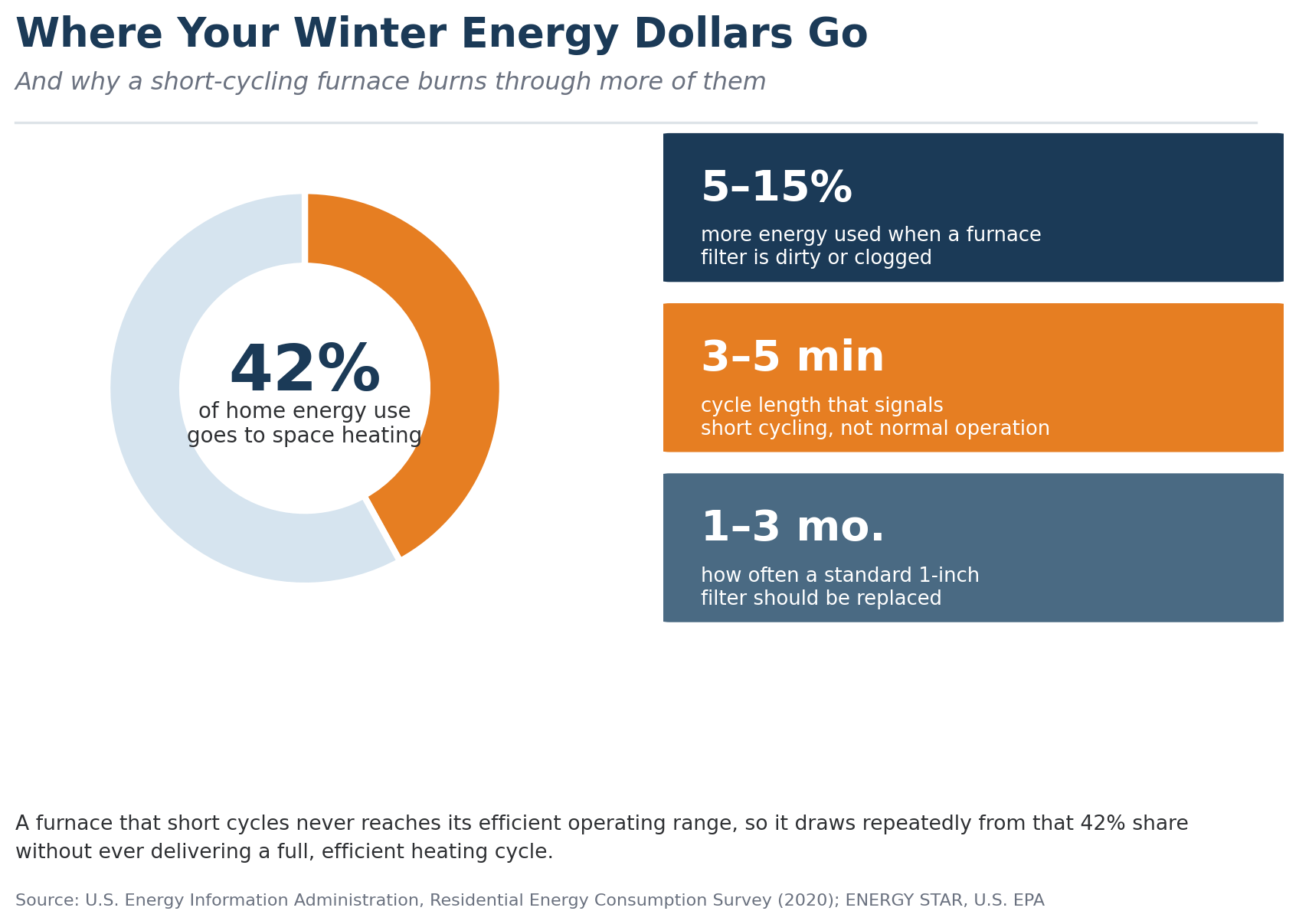
According to the U.S. Department of Energy and ENERGY STAR, nearly half of the energy used in a typical home goes toward heating and cooling, and a dirty filter forces that system to work harder without heating the home any faster. Separately, the U.S. Energy Information Administration reports that space heating alone accounts for 42 percent of energy consumption in the average American home. A furnace that short cycles never reaches its efficient operating range, so it draws repeatedly from that share without ever completing a full, efficient heating cycle.
These checks are worth running before calling anyone:
Check the air filter. Hold it up to a light source. If light cannot pass through the media, replace it. Standard 1-inch filters generally need replacing every one to three months, sooner if there are pets in the home.
Walk through every room. Confirm that most supply registers and return grilles are open and unobstructed. Furniture pushed against a vent or a rug covering a floor register can restrict enough airflow to trigger the problem.
Inspect exterior intake and exhaust pipes. On high-efficiency furnaces with PVC vent pipes exiting through an exterior wall, confirm both pipes are clear of snow, ice, or debris. A blocked exhaust pipe can shut a system down within seconds of startup.
Check the thermostat’s location. A thermostat mounted near a lamp, a sunny window, or a space heater reads a falsely warm temperature and cuts the furnace off early.
If those checks are clear and the furnace still will not complete a cycle, the cause is likely mechanical rather than airflow-related, and it is time to bring in a technician. Our team offers professional furnace repair with 24/7 availability to diagnose the issue and explain exactly what it will take to fix it.
When an Oversized Furnace Is Behind the Cycling
Bigger is not better when it comes to heating equipment. A furnace sized too large for a home will blast the living space up to temperature in just a few minutes. The thermostat registers the target reading, the furnace shuts off, and the house cools back down quickly because heat was never distributed evenly through the ductwork. The cycle repeats continually, some rooms run warm while others stay cold, and indoor humidity swings because short cycles never run long enough to condition the air properly.
The long-term mechanical picture is worse. Because the furnace never runs long enough to reach its optimal operating temperature, moisture can condense inside the heat exchanger instead of venting out through the flue. Over time, that moisture accelerates rust and corrosion in a component that is expensive to replace. Correcting an oversized system starts with a proper load calculation, an assessment of a home’s actual heating demand based on square footage, insulation, ceiling height, and window area, to determine the output it genuinely needs. Where a full system replacement makes sense, a correctly sized furnace installation resolves the cycling permanently instead of masking it.
Signs an oversized furnace may be driving the problem include:
The system blasts hot air for only a few minutes before shutting off, leaving some rooms overheated and others still cold
Heating bills run high despite short run times, because frequent startups consume more energy than fewer, longer cycles would
The behavior has been present since the system was first installed, rather than developing gradually over time
Indoor humidity stays uncomfortably high through the winter because short cycles never pull enough moisture out of the air
The Real Cost of Repeated On-and-Off Cycles
Short cycling does not just leave a home cold. It quietly erodes efficiency and equipment life in ways that add up over a full heating season.
Higher energy bills. Every startup draws a surge of electrical power to ignite the burner and spin the blower motor up to speed. A system starting and stopping dozens of times a day, instead of running fewer, longer cycles, consumes noticeably more energy without delivering proportional heat.
Uneven temperatures. Warm air needs time to travel through ductwork and reach the rooms farthest from the furnace. Short cycles cut that process off before it finishes, leaving distant rooms colder than the rest of the house.
Faster wear on components. Each startup and shutdown puts the heat exchanger through a cycle of thermal expansion and contraction. Metal fatigues under repeated stress, and a heat exchanger that should last the life of the system can crack years ahead of schedule.
Many homeowners assume a short-cycling furnace means a full system replacement is unavoidable, but that is usually not the case. Most short-cycling issues resolve with straightforward, affordable repairs such as cleaning a flame sensor, replacing a worn limit switch, or correcting a thermostat wiring issue.
When Furnace Cycling Signals a Safety Problem, Not Just a Comfort Issue
When restricted airflow is not the culprit, the problem almost always lives inside the furnace’s control and safety systems, and that is where DIY troubleshooting reaches its limit.
The flame sensor is a small metal rod that confirms a flame is present after the gas valve opens. When it becomes coated with oxidation or residue, it can no longer read the flame reliably and shuts the system down within seconds as a precaution against unburned gas collecting in the cabinet. Cleaning it takes a technician about fifteen minutes. The high-limit switch is another common failure point. If it is degrading, it may trip at completely normal operating temperatures, cutting the burner off even when nothing is actually overheating.
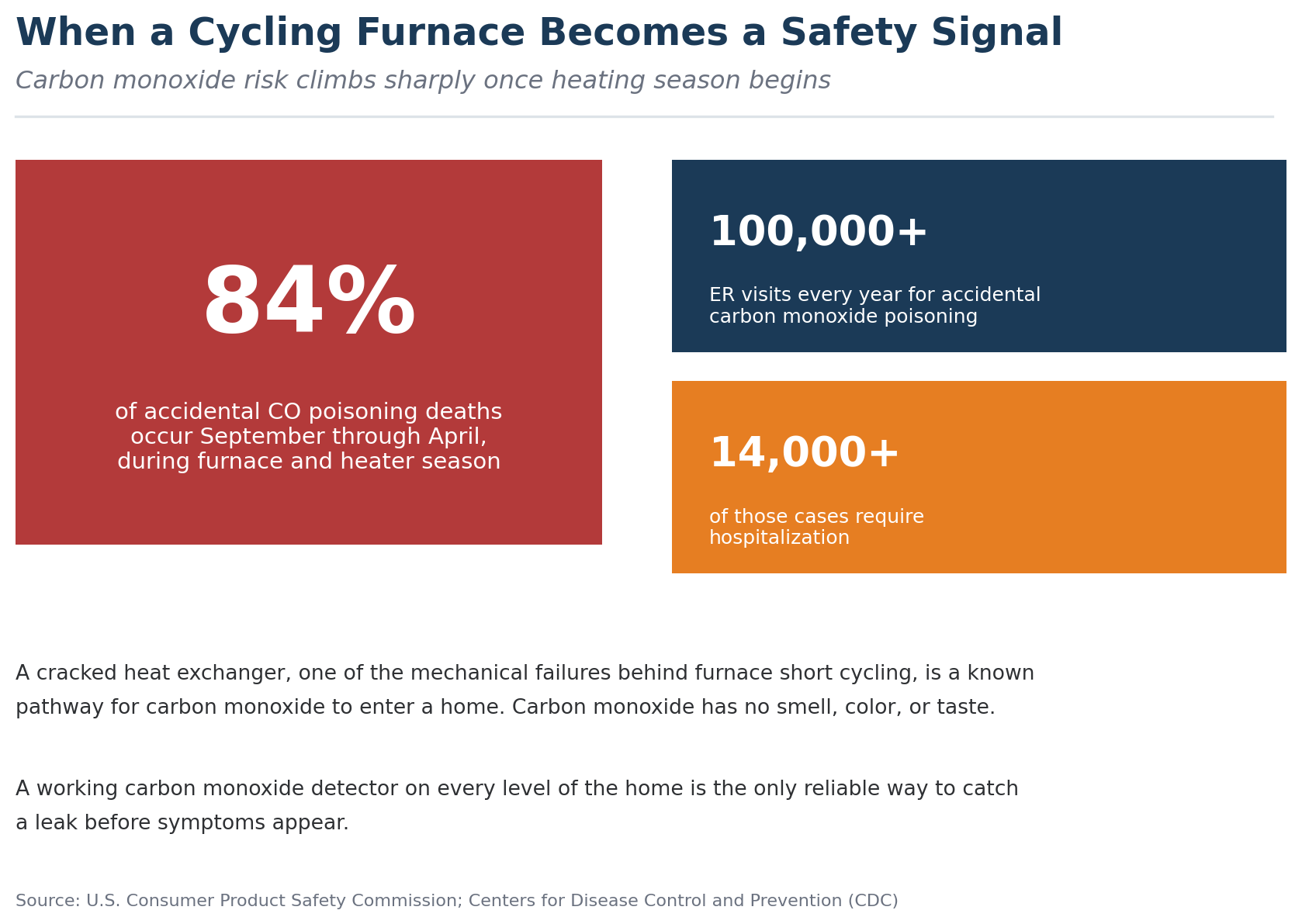
The most serious scenario is a cracked heat exchanger. Short cycling can both cause and result from this kind of damage. The repeated thermal stress of constant on-and-off cycles weakens the metal, and a crack allows combustion byproducts, including carbon monoxide, to migrate into the living space. Carbon monoxide has no odor and no color, which is exactly why a short-cycling furnace that has been ignored for weeks represents a genuine safety concern rather than just an inconvenience.
The seasonal data on this is worth taking seriously. According to USAFacts, citing data from the Consumer Product Safety Commission and the Centers for Disease Control and Prevention, roughly 84 percent of accidental carbon monoxide poisoning deaths occur between September and April, the exact months furnaces and portable heaters are running. More than 100,000 people visit an emergency room for accidental carbon monoxide poisoning every year, and over 14,000 of those cases require hospitalization.
If a furnace has been short cycling for any length of time and there is no working carbon monoxide detector in the home, installing one today is a reasonable precaution, not an overreaction.
Professional Diagnosis and Repair
The good news is that most short-cycling problems are fixable without a full system replacement, provided they get caught before repeated overheating or a safety trip causes lasting damage. A technician will typically test the flame sensor, check the limit switch, inspect the heat exchanger for cracks, and confirm the system is properly sized for the home before recommending a repair. Our team at Schneider Plumbing, Heating and Air Conditioning has been fixing these exact problems since 1948, and we would rather diagnose the actual cause than push an unnecessary replacement.
Whether the fix turns out to be a new filter, a cleaned flame sensor, or a correctly sized replacement system, catching the issue early protects comfort, utility bills, and household safety through the coldest months of the year.
Preventing Short Cycling Before It Starts
A little routine maintenance goes a long way toward keeping a furnace running in full, efficient cycles all winter:
Check the filter monthly and replace it on schedule, sooner if pets or heavy dust are a factor
Keep supply registers and return grilles clear of furniture, rugs, and drapes
Clear snow, ice, and debris away from exterior intake and exhaust pipes after every storm
Schedule an annual professional tune-up before the coldest months arrive, ideally in the fall
Install a carbon monoxide detector on every level of the home and test it twice a year
A thorough seasonal furnace tune-up covers all of the components most likely to cause short cycling, including the flame sensor, limit switch, and heat exchanger, before they turn into a mid-winter breakdown.
Frequently Asked Questions About Furnace Short Cycling
How long should a furnace run before it shuts off?
A normal heating cycle typically lasts ten to twenty minutes, depending on the outside temperature and how well the home retains heat. Short cycling is generally defined as the furnace shutting off in under three to five minutes without completing that process. It is a practical diagnostic baseline rather than a strict industry rule, but consistent shutoffs well under five minutes usually point to a real problem.
Should I turn off my furnace if it keeps short cycling?
Yes. Shutting the system down at the thermostat or the breaker while waiting for a technician is the right call. A furnace that is repeatedly overheating or tripping a safety control can sustain further damage to the heat exchanger and blower motor if it keeps running, so limiting that exposure is worthwhile.
What is the most common cause of a furnace turning on and off repeatedly?
A dirty filter. When the filter is clogged, return airflow drops, the heat exchanger overheats quickly, and the high-limit safety switch shuts the burner down to prevent damage. It is the first thing worth checking, since replacing a filter costs far less than the repairs that can follow if it goes unnoticed.
Is a short cycling furnace dangerous?
The short cycling itself is a safety mechanism doing exactly what it is designed to do, but the conditions that trigger it can be genuinely hazardous. Restricted airflow sustained over time can crack a heat exchanger, creating a pathway for carbon monoxide to enter the living space. Getting a cycling furnace diagnosed promptly is about household safety, not just comfort.
Will an annual tune-up prevent short cycling?
In most cases, yes. A seasonal tune-up catches the small issues, a dirty flame sensor, a degrading limit switch, a filter overdue for replacement, before they cause the furnace to shut down mid-cycle. It is the most reliable way to keep a system running in full, efficient cycles through an entire winter.
Get a Cycling Furnace Fixed Before It Gets Worse
A furnace that will not finish a full heating cycle is telling you something is wrong, and the longer that signal goes unanswered, the more expensive the fix tends to become. Schneider Plumbing, Heating and Air Conditioning has been a family-owned business since 1948, now serving its third generation of customers, and we would rather give a straight answer and fix the actual problem than sell an upgrade nobody needs.
If your furnace keeps turning on and off, get in touch with our team to schedule a diagnosis before a simple fix turns into a bigger repair.
A furnace making a rattling noise can be more than a minor household annoyance. While some furnace sounds are normal during startup and shutdown, persistent rattling often points to loose parts, airflow problems, worn components, or more serious internal damage. In some cases, the noise may even signal a safety concern that should be addressed before the system continues running. Understanding what causes furnace rattling can help homeowners respond quickly, prevent expensive repairs, and protect their home’s heating system from avoidable failure.
When temperatures drop, your furnace becomes one of the most important systems in your home. It keeps your living spaces warm, supports indoor comfort, and helps protect plumbing, flooring, and other household materials from cold-related issues. Because the furnace plays such a critical role, unusual noises should never be ignored. A rattle may start small, but if the underlying issue worsens, it can lead to broken components, reduced efficiency, poor heating performance, or even a complete system shutdown.
Below, we’ll explain what rattling furnace noises may mean, the mechanical issues that can cause them, how to reduce the risk of furnace damage, and when it’s time to call a professional HVAC technician.
What a Furnace Making a Rattling Noise Means
A rattling noise usually means something inside or around the furnace is loose, vibrating, worn, or out of balance. Furnaces contain several moving and non-moving parts that must stay properly secured for the system to operate safely and efficiently. When one of those parts shifts out of place, loosens over time, or begins to fail, the furnace may make a rattling, clanking, vibrating, or shaking sound.
Some rattling sounds are relatively simple to resolve. For example, a loose access panel may vibrate when the blower motor turns on. In other situations, the sound may indicate a more serious issue, such as a failing blower wheel, damaged motor bearing, cracked heat exchanger, or loose internal hardware.
A furnace may rattle during:
Startup
Shutdown
Continuous heating cycles
Blower operation
High airflow periods
Ignition or burner operation
The timing of the noise can help identify the cause. A rattle that happens only when the blower starts may point to blower assembly issues. A rattle during ignition could be related to burner components. A constant vibration throughout the heating cycle may be caused by loose panels, ductwork, or internal parts.
It’s also important to pay attention to where the noise seems to come from. Rattling near the furnace cabinet may suggest loose exterior panels. Rattling from the duct system may indicate loose metal ductwork. Rattling from deep inside the furnace should be inspected promptly because internal furnace components are not always safe or simple for homeowners to access.
Ignoring furnace rattling can be risky because the underlying problem rarely fixes itself. Loose parts can become looser. Worn bearings can fail. Vibrations can damage nearby components. Airflow problems can strain the blower motor. What begins as an irritating sound can eventually become a costly repair.
Furnace making a rattling noise from loose panels
One of the most common reasons for a furnace making a rattling noise is a loose panel or cover. Furnace access panels are designed to protect internal components, help guide airflow, and keep the unit operating as intended. If a panel is not fully secured, it may vibrate when the furnace turns on.
Loose panels can happen for several reasons:
The panel was not reattached properly after filter replacement
Screws have loosened over time
The furnace cabinet has shifted slightly
Repeated vibration has caused the panel to move
The panel is bent, dented, or misaligned
This type of rattling may sound like a light metallic vibration. It may become louder when the blower motor runs because airflow and motor vibration can cause the loose panel to shake against the furnace cabinet.
Homeowners can sometimes identify this issue by carefully looking at the outside of the furnace. If a panel appears uneven, loose, or not fully latched, that may be the source of the sound. However, the furnace should be turned off before touching panels or attempting basic visual checks. If the panel does not secure easily or the rattling continues after it is properly closed, it’s best to schedule a professional inspection.
Loose panels may seem minor, but they should still be corrected. A poorly secured furnace panel can affect airflow, expose components to dust, or allow vibration to continue spreading through the system. Over time, constant vibration can loosen other parts and contribute to additional wear.
Mechanical Issues That Cause Rattling Sounds
While loose exterior panels are common, many rattling noises come from mechanical problems inside the furnace. These issues are often more serious because they involve components that directly affect heating performance, airflow, ignition, or system safety.
Blower motor and internal component failures
The blower motor is responsible for moving heated air through your ductwork and into your home. Because this part runs frequently during the heating season, it can develop wear over time. If the blower motor or blower wheel becomes loose, damaged, or unbalanced, the furnace may produce a noticeable rattling or banging sound.
Common blower-related causes include:
Loose blower wheel
Worn motor bearings
Bent blower fan blades
Debris caught in the blower assembly
Loose mounting bolts
Motor imbalance
Failing belt in older furnace models
A blower wheel that is loose or off balance can shake while spinning. This creates vibration that may sound like rattling inside the furnace cabinet. If the problem worsens, the blower may scrape, bang, or stop moving air properly. Reduced airflow can cause uneven heating, longer run times, higher energy use, and overheating inside the furnace.
Worn motor bearings can also create rattling, grinding, or squealing noises. Bearings help the motor operate smoothly. When they wear out, the motor may struggle, vibrate, or eventually fail. A failing blower motor is not something homeowners should ignore because it can leave the furnace unable to circulate warm air.
Other internal components can rattle as well. Burners, screws, brackets, wiring, and heat shields must remain secure during operation. If any of these components loosen, they can vibrate when the furnace runs. In some cases, rattling may come from debris inside the furnace cabinet, such as a small object, a piece of insulation, or a broken component fragment.
A cracked heat exchanger can also create unusual noises, including rattling, clicking, or popping. This is a serious safety concern because the heat exchanger separates combustion gases from the air that circulates through your home. If it is damaged, carbon monoxide exposure may become a risk. Not every rattling sound indicates a cracked heat exchanger, but because the possibility is serious, unexplained furnace noises should always be evaluated by a trained HVAC professional.
Ductwork may also be part of the problem. Metal ducts naturally expand and contract as warm air moves through them. This can sometimes cause popping or ticking. However, rattling ductwork may indicate loose connections, unsupported sections, or excessive airflow pressure. If duct rattling is caused by system imbalance or airflow restriction, the furnace may be working harder than necessary.
Mechanical rattling can be caused by several conditions, including:
Loose internal fasteners
Damaged blower wheel
Motor wear
Worn bearings
Debris in the furnace cabinet
Loose ductwork
Expanding and contracting sheet metal
Failing ignition or burner components
Cracked or damaged heat exchanger
Airflow restrictions
Because many of these problems happen inside the furnace, professional diagnosis is the safest and most reliable option. HVAC technicians have the tools, training, and experience to inspect internal components without damaging the system or creating safety hazards.
How to Prevent Furnace Damage
Preventing furnace damage starts with responding to unusual noises early. A rattling furnace is often a warning sign that the system needs attention. The sooner the source of the sound is identified, the easier it may be to prevent larger problems.
Homeowners can take several steps to reduce the risk of furnace damage:
Replace the air filter regularly
Keep return and supply vents open and clear
Avoid storing items too close to the furnace
Listen for changes in furnace sounds
Schedule annual heating maintenance
Keep the area around the furnace clean
Make sure access panels are properly secured
Call for service when noises persist or worsen
A dirty air filter is one of the simplest problems to prevent, but it can have a major impact on furnace performance. When the filter becomes clogged, airflow is restricted. This forces the blower motor to work harder, increases strain on the system, and may contribute to overheating or vibration. Replacing filters according to the manufacturer’s recommendations can help protect the blower motor and improve indoor comfort.
Blocked vents can create similar problems. When furniture, rugs, curtains, or other items block airflow, pressure can build within the duct system. This may cause ducts to rattle or make the furnace run longer to heat the home. Keeping vents open and unobstructed supports balanced airflow and helps the furnace operate more efficiently.
Annual furnace maintenance is one of the best ways to prevent rattling noises and system damage. During a maintenance visit, an HVAC technician can inspect the furnace, tighten loose parts, clean key components, check airflow, test safety controls, and look for signs of wear. This proactive service can catch small problems before they become major repairs.
Maintenance is especially important before the heating season begins. A furnace that has been sitting unused for months may have dust buildup, loose panels, worn components, or other issues that become noticeable once the system starts running regularly again.
Homeowners should also avoid delaying service when the furnace makes new or unusual sounds. Rattling that continues after checking the exterior panel or replacing the air filter should be inspected. Waiting too long may allow damage to spread from one component to another. For example, a loose blower wheel can damage the motor shaft, housing, or surrounding parts if it continues operating while unbalanced.
Why professional furnace inspection matters
A professional furnace inspection is important because rattling noises can have many causes, and not all of them are visible from the outside. While a homeowner may be able to notice a loose panel or dirty filter, internal problems require specialized knowledge and equipment.
During a professional inspection, an HVAC technician may check:
Furnace cabinet panels and fasteners
Blower motor condition
Blower wheel alignment
Motor bearings
Burner assembly
Heat exchanger condition
Ignition system
Electrical connections
Safety switches
Airflow levels
Ductwork connections
Filter condition
Signs of overheating or wear
This detailed approach helps identify both the immediate cause of the rattling and any related issues that could affect system performance. For example, the noise may come from the blower assembly, but the root cause may be restricted airflow due to a clogged filter or duct problem. Addressing only the noise without correcting the underlying issue may lead to repeat repairs.
Professional service is also essential for safety. Furnaces that burn natural gas, propane, or oil involve combustion. Problems with burners, venting, or the heat exchanger can create serious risks. A trained technician can test the system safely and determine whether it is operating within acceptable limits.
Homeowners should turn off the furnace and call for service right away if rattling is accompanied by:
Burning odors
Gas smells
Frequent cycling
Weak airflow
No heat
Loud banging
Yellow or flickering pilot flame
Carbon monoxide detector alerts
Visible damage to the furnace
Smoke or electrical smells
These symptoms may indicate a more urgent issue that requires immediate attention. If you smell gas, leave the home and contact your gas utility or emergency services before calling for HVAC repair.
Even when the noise seems minor, professional inspection provides peace of mind. A technician can determine whether the furnace needs a simple adjustment, component replacement, cleaning, or more extensive repair. In some cases, especially with older systems, recurring rattling may indicate that the furnace is nearing the end of its service life. A professional can help you understand whether repair or replacement is the better long-term option.
FAQ
Why is my furnace making a rattling noise?
A furnace may rattle because of loose access panels, unsecured internal parts, blower motor problems, ductwork vibration, debris inside the cabinet, or worn mechanical components. If the sound continues or gets louder, schedule a professional inspection.
Is a rattling furnace dangerous?
A rattling furnace is not always dangerous, but it can be. Some causes are minor, such as a loose panel. Others may involve failing internal parts, combustion issues, or a cracked heat exchanger. Because safety risks are possible, unexplained rattling should not be ignored.
Can I keep running my furnace if it rattles?
It depends on the severity and cause of the noise. If the rattling is light and you can confirm it is from a loose exterior panel, securing the panel may resolve it. If the sound is loud, persistent, or coming from inside the unit, turn the system off and call an HVAC professional.
How do I know if the blower motor is causing the rattling?
Blower motor issues often create rattling, grinding, humming, or vibration when the fan runs. You may also notice weak airflow, uneven heating, or longer heating cycles. A technician can inspect the blower motor, wheel, bearings, and mounting hardware to confirm the cause.
Can dirty filters cause rattling furnace noises?
A dirty filter may not directly rattle, but it can restrict airflow and strain the blower motor. This extra strain may contribute to vibration, overheating, and unusual system noises. Regular filter replacement helps protect the furnace from unnecessary wear.
How often should I schedule furnace maintenance?
Most homeowners should schedule furnace maintenance once a year, ideally before the heating season. Annual maintenance helps identify loose parts, airflow problems, worn components, and safety concerns before they lead to breakdowns.
When should I replace my furnace instead of repairing it?
Replacement may be worth considering if your furnace is older, needs frequent repairs, struggles to heat your home, makes recurring loud noises, or has a major safety issue such as a cracked heat exchanger. An HVAC professional can help compare repair costs with replacement options.
Call Schneider Plumbing, Heating & Air Conditioning for Furnace Service
If your furnace is rattling, don’t wait for the problem to turn into a breakdown. Schneider Plumbing, Heating & Air Conditioning is here to help homeowners throughout Jackson and Jennings County stay safe, warm, and comfortable. For over 70 years, our team has been a reliable plumber and HVAC company helping friends and neighbors live more comfortably at home.
As a family-owned HVAC company, we are committed to improving customers’ lives through quality heating, cooling, and plumbing services. Whether your furnace needs a simple adjustment, a detailed inspection, or professional repair, our team is ready to provide the highest level of service whenever you need help from an expert.
Schedule service with us today and get dependable help for your rattling furnace before the issue leads to bigger problems.
When you have an AC running but not cooling, it can quickly turn a comfortable home into a frustrating, sticky, and stressful space. Your air conditioner may sound like it is working, the fan may be blowing, and the thermostat may show that the system is on, but the air coming from the vents feels warm, weak, or barely cooler than the room temperature. This is one of the most common cooling problems homeowners experience, especially during long stretches of hot weather when an air conditioner is working harder than usual.
In many cases, an air conditioner that runs without cooling is a sign that something is preventing the system from absorbing heat from inside your home and releasing it outdoors. Sometimes the cause is simple, such as a clogged air filter or an incorrect thermostat setting. Other times, the issue involves refrigerant loss, dirty coils, failing electrical components, or a compressor problem that requires professional AC repair.
Understanding the possible causes can help you decide what to check first, what problems are urgent, and when it is time to call a qualified HVAC technician. Below are the most common reasons an AC system keeps running but fails to cool properly.
Why Your AC Is Running but Not Cooling
An air conditioner does more than blow cold air. It works by moving heat out of your home. Warm indoor air passes over the evaporator coil, where refrigerant absorbs heat. That heat is then carried outside and released through the condenser coil. If any part of this process is interrupted, your system may continue running without delivering the cool air you expect.
A few warning signs can point to a cooling issue, including:
Warm or room-temperature air coming from vents
Weak airflow throughout the home
Uneven cooling from room to room
The AC running constantly without reaching the thermostat setting
Ice forming on the refrigerant lines or evaporator coil
Unusual sounds coming from the indoor or outdoor unit
Higher energy bills without improved comfort
The outdoor unit not turning on while the indoor fan runs
Before assuming the worst, homeowners can check a few basic items. Make sure the thermostat is set to “cool,” and the temperature is set lower than the current indoor temperature. Confirm that the fan setting is on “auto” rather than “on.” When the fan is set to “on,” it may continue blowing air even when the cooling cycle is not active, which can make it seem like the AC is running without cooling.
You should also inspect your air filter. A dirty filter can reduce airflow enough to affect cooling performance. If the filter is clogged with dust, pet hair, or debris, replace it and give the system time to stabilize. Check that vents are open and not blocked by furniture, rugs, curtains, or storage items. Outside, make sure the condenser unit has space around it and is not covered by leaves, grass clippings, or overgrown landscaping.
If these simple checks do not solve the problem, the issue may be inside the cooling system itself.
Common Cooling System Failures
Air conditioners depend on proper airflow, refrigerant pressure, electrical controls, and clean components. When one of these areas fails, the system may still turn on but struggle to cool the home. Some problems develop gradually, while others happen suddenly due to a failed part or damaged connection.
AC is running but not cooling due to refrigerant issues
Refrigerant is essential to your air conditioner’s cooling process. It circulates through the system, absorbing heat from indoor air and releasing that heat outside. If your AC does not have the correct refrigerant charge, it cannot remove heat efficiently.
Low refrigerant is often caused by a leak. Since refrigerant is contained in a closed system, it should not run out under normal conditions. If the level is low, simply adding more refrigerant is not a long-term solution unless the leak is found and repaired.
Signs of a refrigerant problem may include:
Warm air blowing from the vents
Ice buildup on refrigerant lines or coils
Hissing or bubbling sounds near the AC system
Longer cooling cycles
Poor humidity control
Higher utility bills
The system cooling less effectively over time
Refrigerant issues should always be handled by a licensed HVAC professional. Refrigerant must be handled safely and according to applicable regulations. A technician can inspect the system, locate leaks, repair damaged components, and recharge the system to the manufacturer’s specifications.
Ignoring a refrigerant issue can lead to more serious damage. When refrigerant levels are low, the compressor may be forced to work harder. Since the compressor is one of the most important and expensive parts of an air conditioner, prompt repair is the best way to protect the system.
Dirty coils and airflow restrictions
Airflow problems are another major reason an AC runs without cooling. Your system needs steady airflow across the indoor evaporator coil and outdoor condenser coil. If airflow is blocked, restricted, or reduced, the AC cannot transfer heat properly.
The evaporator coil is located inside the indoor portion of the system. When it becomes dirty, dust and debris can create a layer of insulation that prevents the coil from absorbing heat effectively. In some cases, restricted airflow can cause the coil to become too cold and freeze. Once ice forms, cooling performance drops even more.
The outdoor condenser coil can also become dirty. This coil releases heat outside. If it is covered in dirt, grass clippings, cottonwood, leaves, or other debris, the system cannot release heat efficiently. As a result, the AC may run longer, cool poorly, and place extra strain on major components.
Common airflow restrictions include:
Dirty or clogged air filters
Blocked supply or return vents
Dust buildup inside ductwork
Dirty evaporator coils
Debris around the outdoor condenser
A failing blower motor
Damaged or leaking ducts
Closed dampers or improperly balanced airflow
Homeowners can help prevent airflow problems by changing air filters regularly and keeping the area around the outdoor unit clear. Most filters should be checked monthly during peak cooling season, especially in homes with pets, high dust levels, or frequent AC use.
However, coil cleaning and blower motor diagnosis should be left to professionals. HVAC technicians have the tools and cleaning methods needed to remove buildup without damaging sensitive system components.
Thermostat and electrical control problems
Sometimes the air conditioner itself is capable of cooling, but the controls that tell it when and how to operate are not working properly. Thermostat issues and electrical control problems can cause confusing symptoms, including an indoor fan that runs while the outdoor unit does not.
Start with the thermostat. If the thermostat is set incorrectly, placed in direct sunlight, located near a heat source, or losing power, it may not communicate properly with the AC system. Weak batteries, loose wiring, or calibration problems may also prevent the system from cooling as expected.
Electrical issues can involve several components, including:
Capacitors
Contactors
Relays
Control boards
Wiring connections
Breakers
Fuses
Safety switches
Fan motors
For example, the indoor blower may run, but the outdoor condenser may not start because of a failed capacitor or contactor. Without the outdoor unit, the system cannot release heat, so the air from the vents will not cool properly. In other cases, a tripped breaker or blown fuse may shut down part of the system while another part continues operating.
Electrical AC problems should not be handled as a do-it-yourself repair. Air conditioners use high-voltage components that can be dangerous without proper training. A professional technician can test parts safely, confirm the source of the failure, and replace components correctly.
When AC Repair Is the Best Solution
Some AC cooling problems can be improved with basic homeowner maintenance, such as replacing a filter or clearing debris around the outdoor unit. However, professional service is the best solution when the issue involves refrigerant, electrical components, frozen coils, poor airflow from mechanical failure, or repeated performance problems.
You should schedule AC repair if:
The system runs constantly but never reaches the set temperature
Air from the vents is warm or weak
The outdoor unit will not turn on
Ice is visible on the system
You hear buzzing, grinding, rattling, or hissing sounds
The AC trips the breaker repeatedly
Your energy bills have increased unexpectedly
Some rooms are much hotter than others
The system has needed multiple recent repairs
The AC is older and struggling to keep up
Prompt repair can help prevent a small problem from becoming a major system failure. For example, a clogged filter may seem minor, but if it causes frozen coils or blower motor strain, repair costs can increase. A refrigerant leak may start small, but it can eventually damage the compressor. Electrical issues may worsen over time and affect other parts of the system.
Professional AC service is also valuable because cooling issues often have more than one cause. A technician can evaluate the complete system, including thermostat operation, refrigerant pressure, coil condition, blower performance, ductwork, electrical components, and temperature split. This helps ensure the real problem is fixed rather than temporarily masked.
In some cases, the best solution may not be a repair. If your air conditioner is older, inefficient, frequently breaking down, or using outdated components, replacement may be more cost-effective. A professional HVAC company can help you compare repair costs, system age, efficiency, and long-term comfort needs so you can make a confident decision.
Preventive maintenance is another important part of avoiding cooling problems. Annual AC tune-ups help identify worn parts, dirty components, airflow issues, and performance concerns before they lead to breakdowns. Regular maintenance can also improve energy efficiency, extend equipment life, and help your home stay more comfortable during the hottest months.
FAQ
Why is my AC running but blowing warm air?
Your AC may be blowing warm air because of a dirty air filter, low refrigerant, a dirty coil, a thermostat issue, or a problem with the outdoor unit. If changing the filter and checking the thermostat do not help, schedule professional AC service.
Can a dirty air filter stop my AC from cooling?
Yes. A clogged air filter restricts airflow, which can reduce cooling performance and may cause the evaporator coil to freeze. Replacing the filter is one of the first things homeowners should check when the AC is not cooling.
Is low refrigerant normal in an air conditioner?
No. Refrigerant should not run low under normal operation. If your system has low refrigerant, there is likely a leak that needs to be located and repaired by a professional HVAC technician.
Why is my outside AC unit not turning on?
The outdoor unit may not turn on because of a tripped breaker, failed capacitor, bad contactor, wiring problem, thermostat issue, or motor failure. Because electrical components can be dangerous, this problem should be inspected by a professional.
Should I turn off my AC if it is not cooling?
Yes, in many cases it is wise to turn the system off, especially if you see ice, hear unusual noises, or notice the outdoor unit is not working. Continuing to run a malfunctioning AC can make the problem worse.
How often should I replace my AC filter?
Many filters should be checked monthly and replaced every one to three months, depending on the filter type, household dust, pets, allergies, and how often the system runs. During peak cooling season, check it more often.
When should I call for AC repair?
Call for AC repair when basic checks do not restore cooling, the system runs constantly, warm air comes from the vents, ice forms, the breaker trips, or the outdoor unit does not operate. Professional diagnosis can prevent further damage.
Call Schneider Plumbing, Heating & Air Conditioning for Reliable AC Repair
If your AC is running but not cooling, do not wait for the problem to get worse. The experienced team at Schneider Plumbing, Heating & Air Conditioning can inspect your system, identify the cause of the cooling issue, and recommend the right repair for your home.
For over 70 years, we have been a reliable plumber helping friends and neighbors throughout Jackson and Jennings County live more comfortably at home. As a family-owned HVAC company, we are committed to improving customers’ lives through quality heating, cooling, and plumbing services. Our mission is to provide the highest level of service whenever you need help from an expert.
Whether you are dealing with weak airflow, warm air, refrigerant concerns, thermostat problems, or a system that will not keep up, Schneider Plumbing, Heating & Air Conditioning is ready to help. Contact us to schedule service and restore comfort to your home.
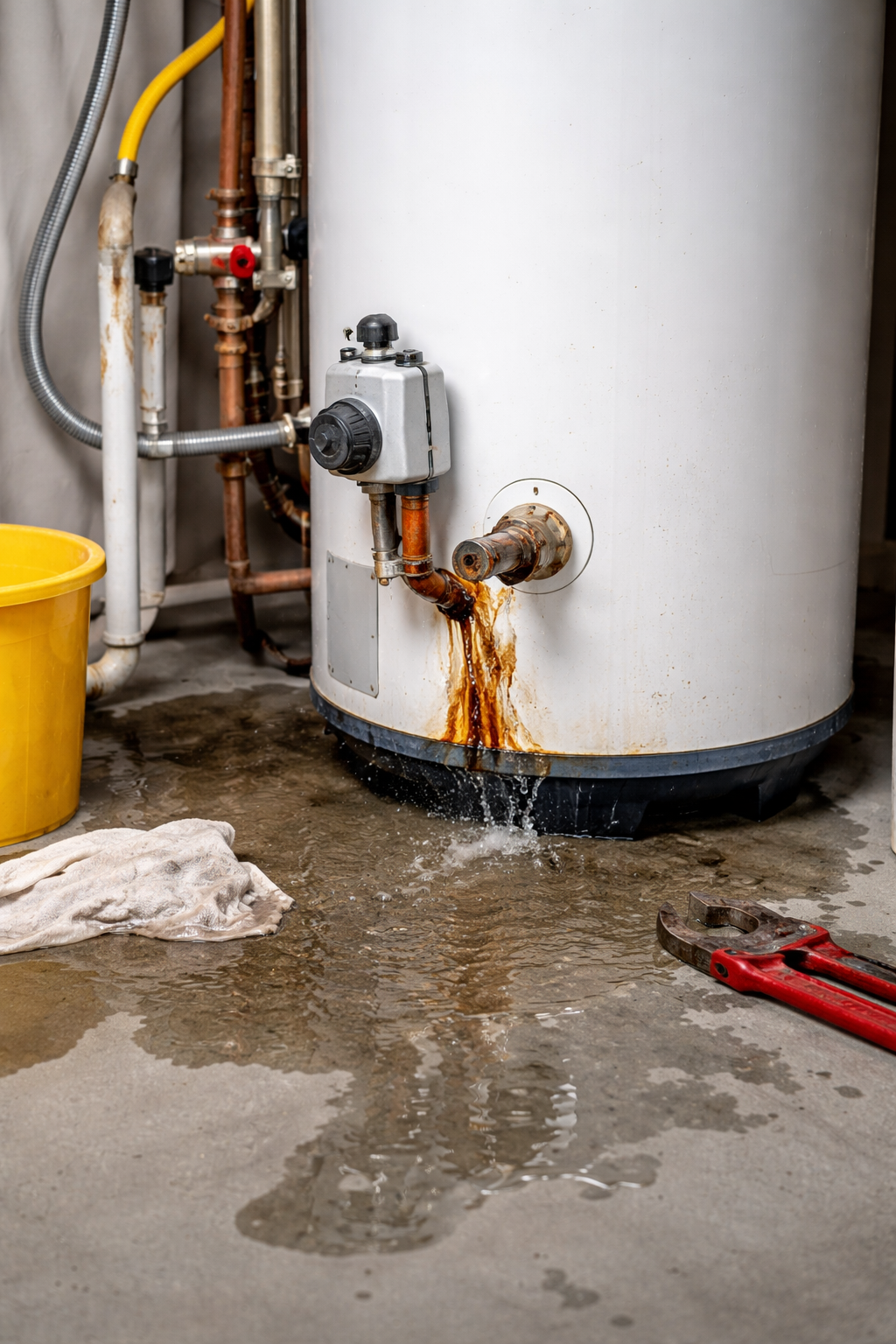
A water heater leaking from the bottom is one of the most concerning plumbing issues a homeowner can face. While some leaks may seem minor at first, water pooling around the base of your unit often signals a deeper problem that can quickly escalate into costly damage. From internal tank corrosion to failing components, bottom leaks should never be ignored. Understanding the causes and knowing what steps to take immediately can help you protect your home, avoid water damage, and restore your hot water supply as quickly as possible.
Why a Water Heater Leaking from the Bottom Is Serious
When a water heater begins leaking from the bottom, it is rarely a superficial issue. Unlike leaks from fittings or connections, bottom leaks often originate from inside the tank itself or from critical safety components. This makes them particularly serious for several reasons:
Potential tank failure: A leak at the base may indicate that the internal tank lining has corroded and failed.
Rapid water damage: Water can quickly spread across floors, seep into subflooring, and damage nearby walls or belongings.
Mold and mildew growth: Persistent moisture creates the perfect environment for mold, which can affect indoor air quality.
Reduced efficiency or total failure: A leaking unit will struggle to maintain proper operation and may stop producing hot water altogether.
Safety concerns: In gas water heaters, leaks can impact burner performance. In electric units, water exposure can create electrical hazards.
Because of these risks, any signs of water collecting beneath your water heater should be treated as urgent.
Common Causes of Bottom Water Heater Leaks
There are several reasons why water might appear at the base of your unit. Identifying the root cause can help determine whether a repair is possible or if replacement is necessary.
Water heater leaking from the bottom due to tank failure
One of the most common and serious causes of a bottom leak is internal tank failure. Over time, the inside of a water heater tank is exposed to minerals, sediment, and constant heating and cooling cycles. Even with protective linings, corrosion can develop.
Key factors that contribute to tank failure include:
Age of the unit: Most water heaters last between 8 to 12 years. Older units are more prone to corrosion.
Sediment buildup: Minerals in hard water settle at the bottom of the tank, creating a layer that traps heat and accelerates wear.
Anode rod depletion: The anode rod is designed to attract corrosive elements. Once it wears out, the tank itself becomes vulnerable.
When the tank fails, water escapes from the bottom and cannot be repaired. In these cases, replacement is typically the only solution.
Pressure relief valve and internal corrosion issues
Another potential cause of water pooling near the base is related to the temperature and pressure relief valve or internal corrosion affecting fittings and seals.
The pressure relief valve is a critical safety feature that releases excess pressure inside the tank. If it malfunctions or if pressure builds too high, water may be discharged and travel down to the base of the unit.
Other related issues include:
Loose or worn drain valves: The drain valve at the bottom of the tank may loosen or degrade over time.
Corroded fittings: Connections inside the unit may deteriorate and allow water to escape.
Excessive pressure buildup: This can force water out of valves and seals, leading to visible pooling.
While some of these issues can be repaired, they still require prompt attention to prevent further damage.
Preventing water damage from sudden leaks
Even a small leak can quickly become a major problem if left unchecked. Taking immediate steps when you notice water at the base of your heater can significantly reduce the risk of damage.
Here is what homeowners should do right away:
Turn off the power or gas supply: This helps prevent safety hazards and further damage.
Shut off the water supply: Locate the cold water shutoff valve above the heater and turn it off.
Drain the tank if necessary: This can help reduce pressure and minimize leakage.
Remove standing water: Use towels or a wet vacuum to clean up water and prevent it from spreading.
Move nearby items: Protect belongings from water exposure.
Taking these steps buys you time while you arrange for professional service.
When to Call a Professional for Water Heater Repairs
While some minor issues like a loose valve may seem manageable, most bottom leaks require expert evaluation. Calling a professional plumber is the safest and most effective way to address the problem.
You should contact a professional immediately if:
The leak is coming directly from the tank
Water is pooling rapidly or spreading
The unit is more than 8 years old
You notice rust, corrosion, or discoloration
There is a lack of hot water or inconsistent performance
You are unsure of the source of the leak
A licensed technician can:
Perform a thorough inspection of the unit
Identify whether repair or replacement is needed
Safely handle gas or electrical components
Ensure the system meets safety standards
Recommend energy efficient upgrade options if necessary
Attempting to repair a failing tank on your own can lead to further damage or safety risks. Professional service ensures the issue is handled correctly the first time.
FAQs
Is a water heater leaking from the bottom always a sign of failure?
Not always, but it is often a serious indicator. While some leaks may come from valves or fittings, many bottom leaks are caused by internal tank damage.
Can I still use my water heater if it is leaking?
It is not recommended. Continuing to use a leaking unit can worsen the problem and increase the risk of water damage or safety hazards.
How long does it take to replace a water heater?
In most cases, a professional can replace a water heater within a few hours, depending on the complexity of the installation.
What is the average lifespan of a water heater?
Traditional tank water heaters typically last 8 to 12 years. Proper maintenance can extend their lifespan.
How can I prevent my water heater from leaking?
Regular maintenance is key. This includes flushing the tank annually, checking the anode rod, and inspecting valves and connections.
Does homeowners insurance cover water heater leaks?
Coverage depends on your policy and the cause of the leak. Sudden and accidental damage is often covered, while neglect or wear and tear may not be.
Protect Your Home with Expert Help from Schneider Plumbing, Heating & Air Conditioning
A water heater leaking from the bottom is not something to ignore. Acting quickly can prevent extensive damage and restore comfort to your home. Whether you need a repair, replacement, or routine maintenance, having a trusted professional on your side makes all the difference.
For over 70 years, Schneider Plumbing, Heating & Air Conditioning has proudly served homeowners throughout Jackson and Jennings County. As a family-owned company, our team is dedicated to delivering dependable plumbing, heating, and cooling services that improve everyday comfort. With a strong commitment to quality workmanship and customer care, Schneider is the name homeowners trust when they need expert service.
If you are dealing with a leaking water heater or want to ensure your system is in top condition, do not wait. Contact our team to schedule service. Experience the peace of mind that comes from working with professionals who put your home and comfort first.