Flooding and water damage are among the most costly and disruptive problems homeowners face. For those living in areas prone to heavy rainfall, snowmelt, or high groundwater, sump pump installation can be a critical step toward protecting your home’s foundation, belongings, and long-term value. Whether your basement has flooded before or you are taking proactive steps before the next rainy season, understanding when and why to install a sump pump could save you thousands.
What a Sump Pump Does and Why It Matters
A sump pump is a device installed in the lowest point of a basement or crawlspace, typically inside a specially constructed pit called a sump basin. Its job is to collect water that accumulates around your foundation and pump it safely away from the home before it causes damage.
When water rises in the sump pit, whether from heavy rain, snowmelt, or rising groundwater, the pump activates automatically and moves that water to a designated drainage area such as a dry well, storm drain, or municipal sewer. The result is a drier, safer basement without you having to do a thing.
A properly installed sump pump system:
Prevents basement flooding and the property damage that follows
Protects against mold and mildew, which can develop within 24 to 48 hours of water intrusion
Preserves structural integrity by keeping foundation walls consistently dry
Adds measurable value to your home by reducing flood risk for future buyers
Reduces the risk of costly water leak damage going undetected beneath flooring and behind walls
Signs That Sump Pump Installation Is Necessary for Your Home
Most homeowners do not think about sump pumps until water is already on the basement floor. Catching the warning signs early is far less expensive than responding to a flood after the fact.
Your Basement Has a History of Moisture or Flooding
Even a single flood event is a strong signal that your home is vulnerable. But flooding is not the only indicator. Watch for these early warning signs:
Water stains along the base of basement walls or on the floor
Efflorescence, the white chalky residue left behind when water evaporates through concrete
Musty odors that suggest mold or mildew growth behind finished surfaces
Peeling paint, warped paneling, or bubbling drywall
Pooled water during or after heavy rainfall, even if it drains on its own
Any of these signs warrants a professional assessment. In many cases, sump pump installation in Seymour can be scheduled and completed before the next major rain event.
Your Home Is in a Low-Lying or High Water Table Area
Homes in valleys, near rivers or streams, or on soil with poor natural drainage face a higher baseline risk of water intrusion. Indiana’s geography, with its mix of clay-heavy soils and seasonal flooding, makes this a real concern throughout Jackson and Jennings County. If your property sits in a flood zone or has a high water table, a sump pump is not optional, it is essential.
Not sure about your property’s flood risk? The FEMA Flood Map Service Center allows you to look up your address and see your official flood zone designation.
Your Area Gets Frequent or Heavy Storms
Southern Indiana regularly sees intense spring and summer thunderstorms that drop large amounts of rainfall in short windows. When the ground is already saturated, stormwater has nowhere to go but through cracks in your foundation. Even homes that have never flooded can become vulnerable after a series of heavy storms that raise the local water table.
You Are Finishing or Renovating Your Basement
If you are investing money in flooring, drywall, insulation, or electrical work in your basement, protecting that investment should be part of the plan. Even minor water intrusion after a renovation can destroy materials that cost far more to repair than the sump pump would have cost upfront. Installing a sump pump before finishing a basement is standard practice for good reason.
You Recently Purchased a Home Without One
Not all homes come equipped with sump pumps, particularly older construction. If your home inspection flagged moisture concerns or you purchased a home with a basement in a wet climate, adding a sump pump is one of the smartest first investments you can make as a new homeowner.
Sump Pump Installation: Types of Systems and How to Choose
Submersible Sump Pumps
Submersible pumps sit directly inside the sump pit and operate fully submerged during use. They are quieter than pedestal models, handle higher water volumes, and are the preferred choice for homes with serious or recurring flooding. They tend to cost more upfront but offer a longer operating lifespan and greater reliability under heavy demand.
Pedestal Sump Pumps
Pedestal pumps mount above the sump basin with only the intake extending into the pit. They are easier to access for servicing and generally less expensive. They work well in homes with smaller pits or lighter, less frequent water exposure. The motor is exposed above the water line, making it simpler to maintain but slightly louder during operation.
Which Type Is Right for Your Home?
The right choice depends on your sump pit dimensions, the volume of water your basement typically sees, and your budget. A licensed plumber in Seymour can evaluate your specific situation and recommend the correct pump type, motor size, and discharge setup to keep your basement dry in even the worst conditions.
Battery Backup Systems: Why They Matter More Than You Think
Here is a scenario that plays out regularly during Indiana storms: the power goes out at the exact moment your basement needs the sump pump most. Without a battery backup, the pump is useless during the outage, and water rises unchecked.
A battery backup sump pump system automatically activates when the primary pump loses power, providing continuous protection even during extended outages. Some systems include smart monitoring that sends alerts to your phone if the backup engages or if battery levels drop. For a detailed look at what backup systems cost and which options offer the best value, see our breakdown of sump pump battery backup costs.
Adding a battery backup at the time of initial installation is almost always less expensive than retrofitting one later.
Sump Pump Installation Cost: What to Expect
Professional sump pump installation including parts and labor typically runs between $1,000 and $3,000 depending on:
Cost Factor
Low End
High End
Pedestal pump (parts + labor)
$500
$1,200
Submersible pump (parts + labor)
$800
$2,000
Battery backup system
$300
$1,000
Sump pit excavation (new install)
$500
$1,500
Discharge line extension
$100
$500
To put this in perspective: a single basement flood averages $10,000 to $30,000 in water damage repairs according to industry estimates. A properly installed sump pump system is one of the highest-return protective investments a homeowner can make.
The Professional Installation Process: Step by Step
Sump pump installation is not a DIY project. Proper installation requires an understanding of soil conditions, local water table behavior, building codes, and electrical safety. Here is what professional installation typically involves:
Site Assessment: Evaluating your basement or crawlspace to identify the lowest point and best sump pit location relative to your drainage needs.
Pit Excavation: Digging the sump basin and setting up gravel bed and drainage tile if needed.
Pump and Basin Installation: Setting the pump, liner, discharge line, and check valve to prevent backflow.
Electrical Connection: Connecting the pump to a dedicated circuit with GFCI protection and installing battery backup wiring if applicable.
Testing and Verification: Running the system through multiple cycles and confirming the discharge line routes water well away from the foundation.
Errors during any of these steps can result in a pump that fails when you need it most or one that discharges water back toward the home. Always use a licensed professional for this work.
How Long Does a Sump Pump Last?
The average sump pump lasts 7 to 10 years with regular maintenance. Submersible models may reach the lower end of that range due to constant submersion, while pedestal models in lighter-use situations can exceed 10 years. Signs your existing pump may be nearing the end of its useful life include:
Unusual noises such as rattling, grinding, or excessive vibration
Running continuously without shutting off
Visible rust or corrosion on the pump body or pit liner
Slow or inconsistent water removal
The system is 7 or more years old and has never been serviced
If your pump is showing any of these signs, do not wait for a flood to confirm the failure. Proactive replacement before storm season is far less stressful and less expensive than an emergency call in the middle of the night.
Sump Pump Maintenance: Keeping Your System Ready Year-Round
Installing a sump pump is only part of the equation. Regular maintenance ensures it performs when conditions demand it most.
Test it quarterly: Pour a bucket of water into the pit and confirm the float activates the pump and the water discharges properly.
Clean the pit annually: Remove debris, gravel, and sediment that can clog the intake screen.
Inspect the discharge line: Make sure the outlet is clear of ice in winter and that water is directed well away from the foundation.
Check the battery backup: Test backup battery charge and replace the battery every 3 to 5 years even if it appears functional.
Schedule professional service: An annual inspection by a local plumber in Seymour catches issues before they become failures.
When Is the Best Time to Schedule Sump Pump Installation?
The best time to install a sump pump is before you need it. Specifically, consider scheduling installation:
Before spring thaw and Indiana’s peak rainy season (March through June)
Before finishing or renovating a basement space
Shortly after purchasing a home that lacks an existing system
After noticing any signs of moisture, even if flooding has not occurred yet
When replacing an aging pump that is 7 or more years old
Emergency installations during an active flood are possible but cost more, take longer, and often cause unnecessary stress. Planning ahead gives you time to choose the right system and get the job done properly.
Is sump pump installation necessary if my basement has never flooded?
Yes, in many cases. A basement that has never flooded may still be at risk due to soil type, proximity to water sources, or aging foundation waterproofing. A sump pump acts as insurance against future water intrusion. An inspection by a sump pump installation professional in Seymour can help you assess your actual risk level.
How deep does a sump pit need to be?
Most sump pits are dug to a depth of 18 to 24 inches and measure roughly 18 inches in diameter, though the exact dimensions depend on your water volume and pump type. Your installer will size the pit based on a site assessment rather than a one-size-fits-all spec.
Can I install a sump pump myself?
Technically yes, but it is not recommended. Improper pit sizing, incorrect float settings, poor discharge routing, or faulty electrical connections can all result in a system that fails at the worst possible moment. Licensed installation ensures the job meets local code and the system performs as intended.
What happens if the power goes out during a storm?
Without a battery backup, your sump pump will not operate during a power outage. Since outages frequently accompany the same storms that stress your drainage system most, a battery backup is a critical companion to any primary sump pump. Review your backup options in our guide to sump pump battery backup costs.
Does homeowners insurance cover sump pump failure?
Standard homeowners insurance typically does not cover damage from sump pump failure or basement flooding. You may be able to add a water backup endorsement to your policy for an additional premium. Check with your insurance provider for details specific to your coverage.
How long does sump pump installation take?
For a straightforward replacement of an existing pump in an already-established pit, installation typically takes 2 to 4 hours. New installations requiring pit excavation may take a full day. Your contractor can give you a firm timeline during the assessment.
Protect Your Home Before the Next Storm
Water damage can be devastating, but with the right protection in place, your home’s foundation and lower level can stay dry through whatever Indiana weather brings. Schneider Plumbing, Heating & Air Conditioning has been protecting homes throughout Jackson and Jennings County for over 70 years. Our licensed team will assess your basement, recommend the right system, and install it to last.
Do not wait until you are standing in water to make the call. Contact us today for a professional assessment and a solution built around your home’s specific needs.
The tankless vs tank water heater decision comes down to three things: how much hot water your household uses, which fuel you have, and how long you will stay in the home. Tankless units cost more to install, typically $1,400 to $3,900 against $900 to $2,500 for a tank, but they last 20+ years and use less energy. Tank heaters win on upfront price, simplicity, and heavy simultaneous use.
Is a Tankless Water Heater Better Than a Tank Water Heater?
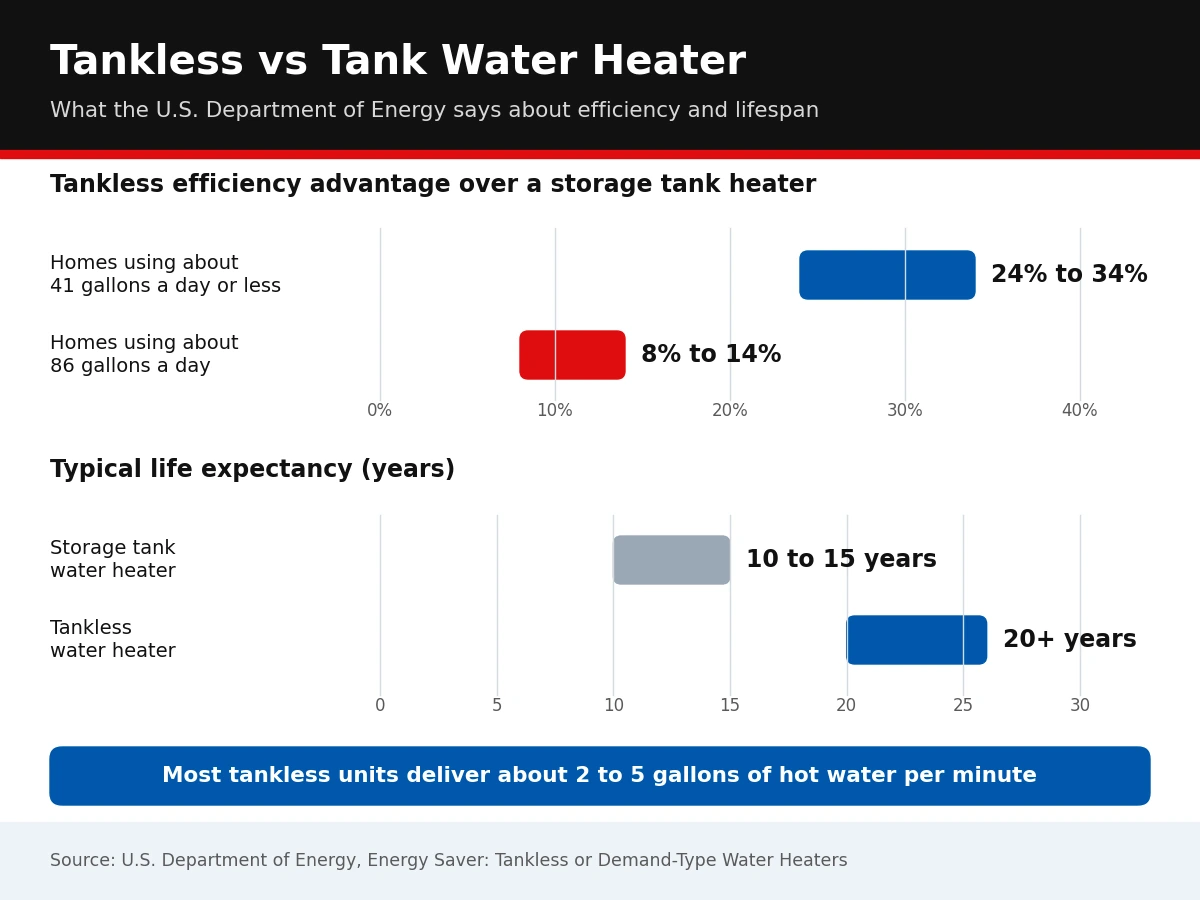
A tankless water heater is better for small to mid-size households that plan to stay in the home 10 years or more, and a tank water heater is better for tight budgets and heavy simultaneous hot water use. The U.S. Department of Energy says tankless units can be 24% to 34% more energy efficient than storage tanks in homes using about 41 gallons of hot water a day or less, and 8% to 14% more efficient in homes using around 86 gallons. Tankless units also last more than 20 years, compared with 10 to 15 years for a tank.
Tankless vs Tank Water Heater: How Each System Works
How a Traditional Tank Water Heater Works
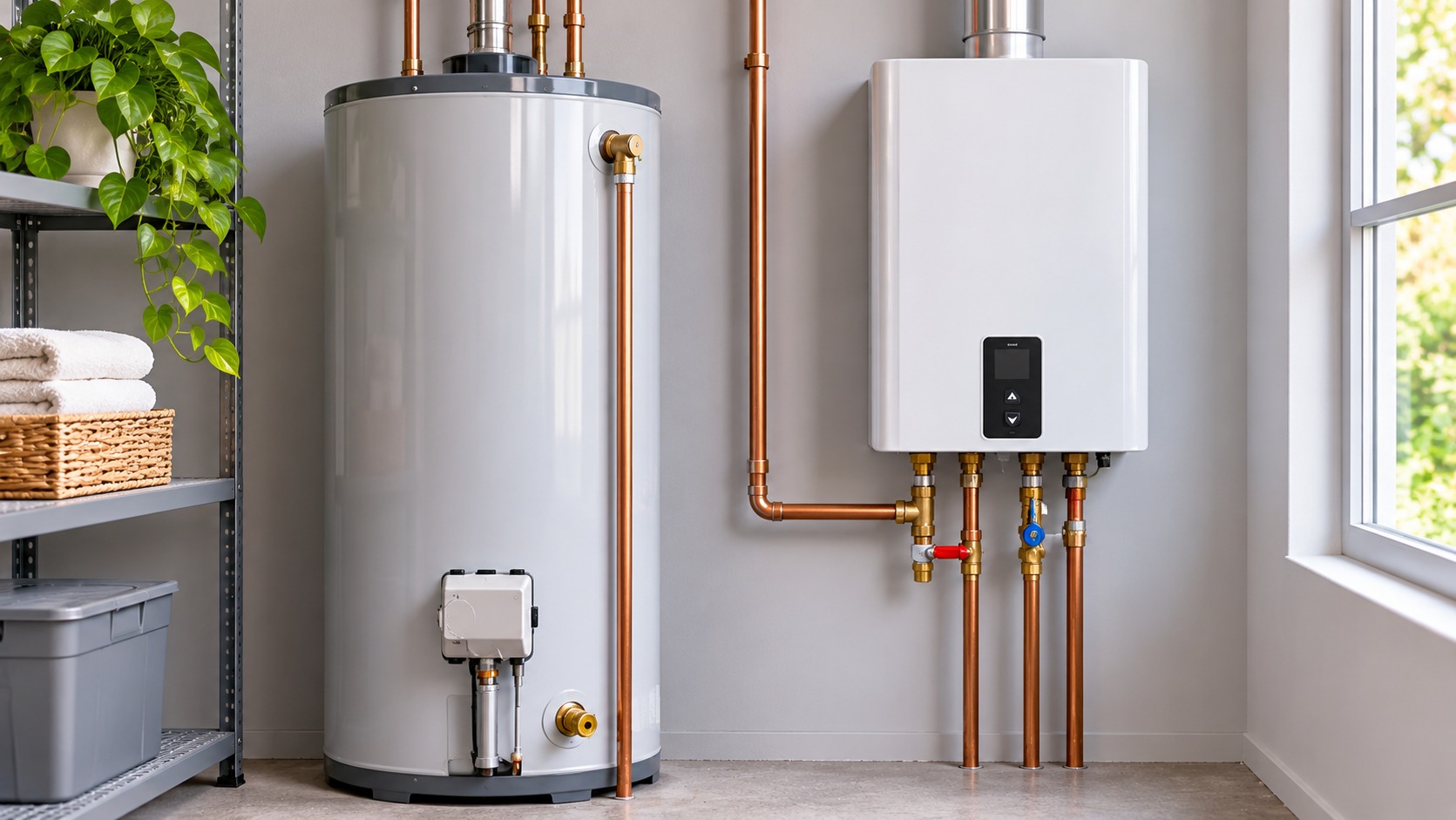
A traditional storage water heater is an insulated tank, typically holding 20 to 80 gallons, that heats water and keeps it ready at a set temperature. When you open a hot tap, hot water leaves the top of the tank and cold water refills the bottom, where the burner or heating elements bring it back up to temperature.
The strength of this design is simplicity and a ready reserve. The weakness is standby heat loss, because the tank keeps reheating stored water day and night, even when no one is home. Once heavy use drains the tank, you wait for it to refill and recover.
How a Tankless Water Heater Works
A tankless water heater, also called a demand-type or instantaneous water heater, has no storage tank. When a hot tap opens, water flows through the unit, where a gas burner or electric elements heat it on the spot. Hot water is produced only when you use it, so there is no standby loss and no tank to run empty.
The limit on a tankless unit is flow rate rather than storage. The Department of Energy reports that most tankless units deliver about 2 to 5 gallons of hot water per minute, and gas-fired models generally produce higher flow rates than electric ones. A single unit can struggle if several fixtures run at once.
Tankless vs Tank Water Heater: Side-by-Side Comparison
Factor
Traditional Tank
Tankless
Typical installed cost
$900 to $2,500
$1,400 to $3,900 (up to $5,600 with upgrades)
Energy efficiency
Standby heat loss
No standby loss; 8% to 34% more efficient per DOE
Life expectancy
10 to 15 years
20+ years
Hot water supply
Limited by tank size, then a recovery wait
Continuous, limited by flow rate (about 2 to 5 gallons per minute)
Space
Needs floor space
Compact, often wall-mounted
Maintenance
Annual flush, anode rod check
Periodic descaling, especially with hard water
Source: U.S. Department of Energy, Energy Saver.
Tankless vs Tank Water Heater Efficiency
Standby Heat Loss
A tank heater constantly works to keep a full tank hot, whether or not anyone uses the water. Tankless units skip that step by heating water only when a tap is open, which is why they generally use less energy for the same amount of hot water.
How Much You Can Actually Save
The Department of Energy puts numbers on the difference. For homes that use about 41 gallons of hot water a day or less, a tankless unit can be 24% to 34% more energy efficient than a conventional storage tank. For homes that use a lot of hot water, around 86 gallons a day, the advantage shrinks to about 8% to 14%. DOE also notes that installing a unit at each hot water outlet can raise the savings to 27% to 50%, though that costs more up front.
The smaller your household’s hot water use, the more a tankless heater helps your bills. A busy household with several showers and appliances running every day will see a smaller percentage gain.
Hot Water Supply and Flow Rate
A tank heater gives you a full reserve at once, so running a shower and a dishwasher together is rarely a problem until the tank runs low. A tankless heater never runs out, but it can only heat so much water per minute. If two showers and a washing machine run at once, a single unit may not keep up. Larger homes often solve this with a higher-capacity unit or two units working in parallel, which adds to the cost.
Incoming water temperature also matters. Colder groundwater in winter means the unit has to work harder to reach your set temperature, which lowers the flow rate it can sustain. Sizing for your coldest months is one of the most important parts of a tankless installation.
Lifespan and Maintenance
The Department of Energy says most tankless water heaters last more than 20 years and have replaceable parts that can extend that further, while storage tank heaters typically last 10 to 15 years. A tank usually fails when the steel corrodes through, and at that point the whole unit has to be replaced.
Both systems need routine care. Tank heaters benefit from an annual flush to clear sediment and a periodic anode rod check. Tankless units need descaling to remove mineral buildup, which matters most where water is hard. If scale is a recurring problem in your home, water softener installation protects either type of heater and extends the life of your fixtures and appliances too.
Space Requirements
Tankless water heaters: compact and typically wall-mounted, which frees up floor space in utility closets, basements, and garages.
Tank water heaters: need a dedicated footprint and clearance for venting, service access, and a drain pan.
Tankless vs Tank Water Heater Cost: Installed Price Comparison
Tankless units cost more to buy and more to install. National 2026 cost data, including Angi’s 2026 water heater replacement cost data, puts a typical tank replacement at $900 to $2,500 and a typical tankless installation at $1,400 to $3,900. Your quote depends on the model, fuel type, and what your home needs.
Cost Item
Traditional Tank
Tankless
Typical installed total
$900 to $2,500 (average about $1,350)
$1,400 to $3,900 (average about $2,600)
Labor alone
$150 to $450
$600 to $1,900
With gas line, venting, or electrical upgrades
Rarely needed
Up to about $5,600
The gap exists because a tankless installation often involves more than swapping one box for another. It may require a larger gas line, new venting, or added electrical capacity, and old connections frequently need to be reworked.
What Can Raise Tankless Installation Costs
Gas line upgrades: tankless burners draw more gas at once, and an existing line may be too small.
New venting: high-efficiency units often need different venting than an old tank heater.
Electrical upgrades: electric tankless models can require significant amperage and dedicated circuits.
Relocating the unit: moving from a tank location to a wall mount changes piping and routing.
Multiple units: larger households may need more than one heater to meet peak demand.
A plumber can check your gas supply, venting, and electrical panel before you commit, so the quote reflects the real scope. Our team handles water heater installation and replacement for tank and tankless systems, including the supporting upgrades that make a new unit perform the way it should.
Tankless vs Tank Water Heater Cost Over 20 Years
Upfront price is only part of the comparison. The Department of Energy says the typical household spends $400 to $600 a year heating water. The table below uses $500 a year, a $1,350 tank installed twice in 20 years (once now, once at replacement), and a $2,600 tankless unit installed once. It applies DOE’s 24% to 34% savings for small households and 8% to 14% for large ones.
Household
Tank, 20 years
Tankless, 20 years
Tankless difference
Small (about 41 gallons a day or less)
$12,700
$9,200 to $10,200
$2,500 to $3,500 less
Large (about 86 gallons a day)
$12,700
$11,200 to $11,800
$900 to $1,500 less
The extra $1,250 a tankless unit costs up front takes about 7 to 10 years to recover in a small household and about 18 to 31 years in a large one. Tankless still comes out ahead over 20 years because it can outlast a second tank purchase, but only if it lasts that long and the install does not need costly upgrades. These are illustrative estimates and exclude descaling and service visits.
Pros and Cons of Tankless vs Traditional Water Heaters
Pros of Tankless Water Heaters
Lower energy use, with DOE savings of 8% to 34% depending on hot water use.
A service life of 20+ years, with replaceable parts.
No standby heat loss and no tank to run out of hot water.
A compact footprint that frees floor space.
No large tank holding gallons of water that could leak.
Cons of Tankless Water Heaters
Higher upfront cost: typically $500 to $1,400 more than a tank, and more when upgrades are needed.
Flow limits: most units top out around 2 to 5 gallons per minute, so overlapping showers can overwhelm one unit.
Installation upgrades: gas lines, venting, or electrical capacity often need work.
Descaling: mineral buildup shortens life and lowers efficiency where water is hard.
Power dependence: most gas models need electricity for ignition and controls, so they stop working in an outage without backup power.
Short delays or cooler bursts: some households notice a brief wait for hot water or a short cool stretch when taps cycle quickly.
Pros and Cons of Tank Water Heaters
Pros: lower purchase and install cost, a ready reserve of hot water, simple technology, and an easy like-for-like replacement.
Cons: standby heat loss, a shorter 10 to 15 year life, a large footprint, and the risk of a tank leak when the steel corrodes. Catching drips early with leak detection can limit water damage before a failing tank is replaced.
How Most U.S. Homes Heat Water
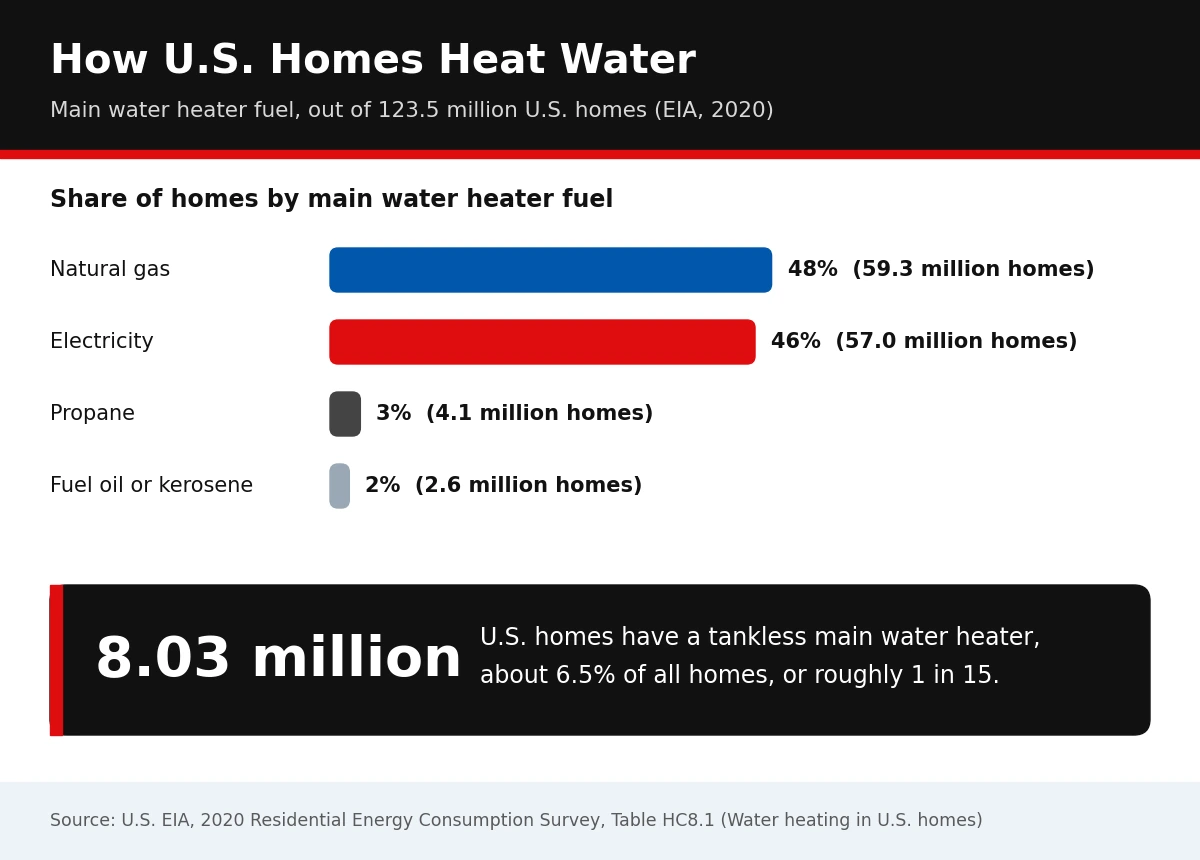
Fuel type shapes both the cost and the performance of whichever system you choose. Federal survey data shows how evenly split the country is between gas and electricity, and how uncommon tankless units still are: about 6.5% of U.S. homes (8.03 million) use one as their main water heater. About 19.3 million homes, roughly 16%, have a main water heater that is 15 years old or older, which is past the typical tank lifespan.
Source: U.S. Energy Information Administration, 2020 Residential Energy Consumption Survey.
Gas vs Electric Tankless Models
Gas-fired tankless heaters generally deliver higher flow rates than electric ones, which makes them the better fit for larger households. Electric tankless models are simpler to vent but can demand a lot of electrical capacity. If your home already has natural gas service, a gas unit is usually the more practical way to get strong flow. If you are all-electric, a tankless unit is still possible, but it deserves a careful look at your panel and wiring.
Heat Pump Water Heaters: A Third Option for Electric Homes
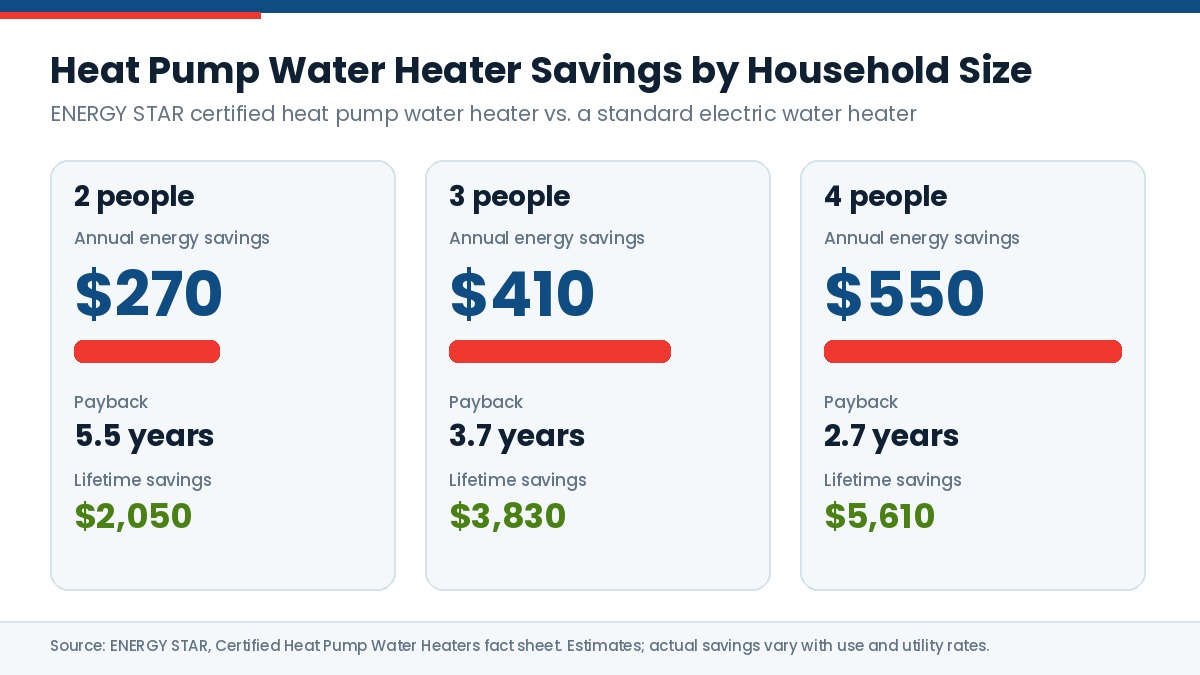
Heat pump water heaters pull heat from the surrounding air instead of generating it directly, and the Department of Energy notes they can be two to three times more energy efficient than conventional electric resistance models. ENERGY STAR estimates a certified heat pump water heater saves a four-person household about $550 a year compared with a standard electric water heater.
Source: ENERGY STAR, Certified Heat Pump Water Heaters fact sheet.
Cost: national cost guides put a heat pump water heater at roughly $2,000 to $4,600 installed, more than a standard electric tank.
Space: they work best in warm, open spaces, so they are not right for every utility closet.
Incentives: the federal tax credit for heat pump water heaters ended for installations after December 31, 2025. Check your utility for rebates before you buy.
How to Size a Tankless or Tank Water Heater
Sizing a Tank Water Heater
Tank heaters are sized by capacity and by first hour rating, the gallons of hot water the unit can deliver in one hour starting with a full tank. Most U.S. homes use a medium tank of 31 to 49 gallons (about 55 million homes) or a large tank of 50 gallons or more (about 47 million homes), according to federal survey data. Pick the size from your busiest hour, not your average day.
Sizing a Tankless Water Heater
Tankless units are sized by flow, in gallons per minute, at a given temperature rise. Temperature rise is the difference between your incoming water temperature and the temperature you want at the tap. Most showerheads use 2.5 gallons per minute or less, so two showers running together can ask for about 5 gallons per minute, the top of the range most units deliver. Add up the fixtures that run at the same time, then size for winter groundwater.
Which Water Heater Is Right for Your Home?
Household Size and Hot Water Habits
One to three people with moderate use: tankless is often an excellent fit, and this is where the efficiency gains are largest.
Large families with overlapping demand: a properly sized tank heater is simpler and less expensive, though a higher-capacity tankless unit or two units can also work.
Budget and Time in the Home
Tight upfront budget or a short stay: a tank heater costs less now and is easier to replace later.
Long-term ownership: a tankless unit’s longer life and lower operating cost can offset the higher price over time.
Space, Climate, and Water Quality
Limited space: tankless frees up floor area.
Cold winters: colder incoming water reduces tankless flow, so sizing matters more.
Hard water: both types need attention, and tankless units typically need descaling on a regular schedule.
Tankless vs Traditional Water Heater: Decision Guide
Your Situation
Better Fit
Small household, low to moderate hot water use
Tankless
Large household with frequent overlapping use
Tank, or a larger tankless setup
Staying in the home 10+ years
Tankless
Lowest upfront cost or planning to sell soon
Tank
Tight utility space
Tankless
All-electric home, enough open air space
Heat pump water heater
Signs Your Tank Water Heater Needs Replacing
Age: a tank at 10 to 15 years is at the end of its expected life.
Rust-colored hot water: corrosion inside the tank or the plumbing.
Rumbling or popping: sediment hardened at the bottom of the tank.
Water around the base: a leaking tank cannot be repaired and needs replacement.
Running out of hot water sooner: a worn element, burner, or heavy sediment.
Most disappointments with either system come from poor sizing or a rushed installation, not from the technology. Have a licensed plumbing contractor review your daily hot water use, fuel type, available space, and local code requirements before you buy.
Tankless vs Tank Water Heater FAQs
Is a tankless water heater better than a tank water heater?
It depends on your household. Tankless units use less energy and last longer, with the biggest savings in homes that use less hot water. Tank heaters cost less up front and handle heavy simultaneous use more easily, so neither is better for every home.
How much more efficient is a tankless water heater?
According to the U.S. Department of Energy, tankless water heaters can be 24% to 34% more energy efficient for homes using about 41 gallons of hot water a day or less, and 8% to 14% more efficient for homes using around 86 gallons a day.
How long do tankless and traditional water heaters last?
The Department of Energy reports that most tankless water heaters last more than 20 years, while storage tank water heaters typically last 10 to 15 years. Proper maintenance helps both types reach the upper end of those ranges.
How much does a tankless water heater cost compared to a tank?
A tank water heater typically costs $900 to $2,500 installed, while a tankless unit typically costs $1,400 to $3,900 installed. Gas line, venting, and electrical upgrades can push tankless costs as high as $5,600.
What are the cons of a tankless water heater?
The main drawbacks are a higher upfront cost, a limit on how much hot water it can deliver at once, possible gas line, venting, or electrical upgrades, and periodic descaling, especially in hard water. Most gas models also need electric power to run, so they do not work in an outage without backup power.
Can a tankless water heater run multiple showers at once?
Sometimes, but flow rate is the limit. Most tankless units deliver about 2 to 5 gallons per minute, and two showers can draw about 5 gallons per minute together. Larger homes often use a higher-capacity unit or more than one unit.
Do tankless water heaters need maintenance?
Yes. Tankless units need periodic descaling to remove mineral buildup, especially where water is hard. Tank heaters need an annual flush and an occasional anode rod check. Regular maintenance protects efficiency and extends the life of either type.
Is a tankless water heater worth it?
It is usually worth it for homeowners who plan to stay many years. Using average installed costs and DOE energy figures, a small household can recover the extra cost in about 7 to 10 years, while a large household can take 18 to 31 years. Because a tankless unit can outlast two tank heaters, it still tends to cost less over 20 years.
Is a heat pump water heater better than a tankless water heater?
For electric homes, often yes. ENERGY STAR estimates a certified heat pump water heater saves a four-person household about $550 a year compared with a standard electric tank. Heat pump models cost more than tanks and need open air space, and the federal tax credit for them ended for installations after December 31, 2025.
Make a Confident Water Heater Decision
There is no single winner in the tankless vs tank debate, only the better match for your home. Tankless units reward moderate hot water use and long-term ownership with lower energy use and a longer life. Tank heaters win on upfront cost and simplicity. Understand your hot water habits, your fuel type, and your timeline, and the right choice usually becomes clear.
Schneider has been family-owned since 1948. If you are weighing a new water heater or your current one is showing its age, talk with our team about your water heater options and we will help you choose the system that fits your household and your budget.
A single hidden leak can quietly waste thousands of gallons of water before anyone notices a problem. What starts as a small drip behind a wall or under a slab can turn into warped flooring, mold growth, and a repair bill that grows by the week. Investing in professional plumbing services for leak prevention is one of the most effective ways to catch these problems early and protect a home’s foundation, walls, and belongings from unnecessary damage.
Why Professional Plumbing Services for Leak Prevention Matter
Water leaks, no matter how minor, can quietly damage a home’s structure and drive up utility bills long before they become obvious. Understanding what goes into proper leak prevention is the first step toward protecting a property from that kind of long term damage.
What Professional Plumbing Services for Leak Prevention Include
A thorough leak prevention plan typically covers more than a single visit. It usually includes:
Routine pipe inspections: Identifying corrosion, weak joints, or early cracking before a pipe fails outright.
Water pressure checks: Confirming pressure stays within a safe range that will not stress fittings and connections over time.
Leak detection technology: Locating hidden leaks behind walls, under floors, or underground without unnecessary digging or demolition.
Prompt repairs: Fixing small issues immediately so they never have the chance to turn into major failures.
Taken together, these steps catch problems long before a homeowner would notice them on their own.
Common Causes of Plumbing Leaks and How to Avoid Them
Most plumbing leaks trace back to a handful of avoidable issues. Recognizing these common culprits makes it easier to take preventive action before a small problem becomes an expensive one.
Aging and Corroded Pipes
Pipes naturally weaken over time as they corrode and develop small cracks. Routine inspections catch aging pipes before they fail, and in some cases pipe repair services can extend the useful life of a section of plumbing rather than requiring a full replacement.
High Water Pressure
Water pressure that runs consistently high puts extra stress on every joint and fitting in a home’s plumbing system. A pressure reducing valve, installed and calibrated by a professional, keeps pressure within a safe range and reduces the odds of a sudden leak or burst pipe.
Tree Root Intrusion
Tree roots naturally seek out moisture, and underground pipes are an easy target once a root finds even a hairline crack. This is especially common with older sewer line repair cases, where roots have worked their way into a joint over several years. Locating and treating root intrusion early prevents a slow blockage from turning into a full backup.
Improper Installation or DIY Repairs
A quick DIY fix or a poorly done installation often leaves joints under sealed or fittings under tightened. These shortcuts tend to hold for a while before failing, which is why professional installation matters just as much as the materials themselves.
Aging Water Heaters and Failing Tank Connections
Water heaters are one of the most overlooked sources of a slow leak. A corroded tank, a loose fitting, or a failing pressure relief valve can drip for weeks before the damage becomes obvious, especially in a basement or utility closet that does not get checked often. Routine attention to water heater repair and installation catches these issues early, before a slow drip turns into a tank failure that floods the surrounding area.
How Plumbers Detect Hidden Leaks
Modern leak detection relies on tools that locate a problem accurately without tearing into walls or flooring unnecessarily. Professional leak detection typically involves a combination of the following:
Acoustic leak detectors: These devices listen for the sound signature of water escaping inside walls, floors, or underground pipes.
Thermal imaging cameras: Infrared technology reveals temperature changes caused by escaping water, even in spaces that are otherwise hard to reach.
Video inspection equipment: Small, flexible cameras travel inside pipes to reveal cracks, blockages, or wear from the inside out.
These tools save time and reduce the amount of demolition needed to locate and fix a leak, which keeps repair costs lower for the homeowner.
Signs You May Have a Hidden Leak
Catching a leak early depends on recognizing the warning signs before damage spreads. A few common indicators include:
Unexplained water bills: A sudden spike with no clear change in water use often points to a hidden leak.
Visible water stains: Discoloration on walls, ceilings, or floors usually means water is finding its way through somewhere it should not be.
Musty odors: Persistent dampness behind walls or under floors creates the ideal environment for mold and mildew.
Low water pressure: A sudden drop in pressure can signal a leak somewhere along the line rather than a fixture problem.
Calling a professional at the first sign of any of these issues keeps a minor repair from turning into an expensive one. The table below offers a quick reference for matching a warning sign to a likely cause.
Where You Notice It
What It Might Mean
Puddling near the water heater
Corroded tank or a loose fitting
Water stain under a sink
Worn supply line or a failing drain trap
Ceiling stain below a bathroom
Toilet or tub seal failure
Soggy yard with no recent rain
Leak in an underground water or sewer line
Why Leak Prevention Saves You Money
Hiring a professional plumber for leak prevention might look like an added expense at first, but it is an investment that typically pays for itself over time.
Avoiding Costly Water Damage
Left unaddressed, leaks can weaken walls, floors, and even foundations, and the moisture they create is a common trigger for mold growth. Furniture, flooring, and other belongings can also suffer damage that is difficult or impossible to reverse once water has soaked in.
Improving Water Efficiency
Household leaks waste far more water than most people realize. According to the EPA WaterSense program, the average home loses thousands of gallons of water every year to leaks that go unnoticed, which quietly adds to monthly utility bills. Addressing leaks quickly keeps a plumbing system running efficiently and keeps that waste out of the water bill.
Extending the Life of Your Plumbing System
Routine maintenance and prompt repairs add years of useful life to a plumbing system. In cases where corrosion or damage has spread through a large section of a home, whole home re-piping services can reset the clock and reduce the odds of another leak developing in the same area down the road.
Seasonal Leak Risks Worth Watching For
Leak risk does not stay constant throughout the year. Cold weather causes water inside pipes to expand as it freezes, and that expansion can crack a pipe from the inside out, often in an unheated crawl space, attic, or exterior wall where the damage goes unnoticed until temperatures rise again. Heavy rain and snowmelt add a different kind of pressure, pushing more water toward sump pumps and foundation drains than they normally handle. A quick pre season check of exposed pipes, sump pump function, and any connections near an exterior wall goes a long way toward catching a seasonal leak before it becomes a seasonal flood.
Trust an Experienced Team With Your Plumbing System
The team at Schneider Plumbing, Heating & Air Conditioning has spent more than 70 years helping homeowners keep their plumbing systems reliable and leak free. Whether it is a routine inspection, a hidden leak that needs tracking down, or a repair that cannot wait, experienced plumbers bring the tools and know how to handle it correctly the first time.
Frequently Asked Questions
How often should I have my plumbing inspected for leaks?
Most homes benefit from a professional plumbing inspection once a year, though older homes or homes with a history of leaks may benefit from more frequent checks.
Can high water pressure really cause a leak?
Yes. Consistently high water pressure puts ongoing stress on pipes, joints, and fittings, which increases the likelihood of a leak or a sudden pipe failure over time. A pressure reducing valve helps keep pressure within a safe range.
What is the most common sign of a hidden leak?
An unexplained spike in a water bill is one of the most common signs of a hidden leak, especially when there has been no noticeable change in household water use.
Do tree roots really cause plumbing leaks?
Yes. Tree roots are drawn to the moisture inside underground pipes and can work their way into small cracks or loose joints over time, eventually causing leaks or blockages.
Is professional leak detection worth the cost?
Professional leak detection typically costs far less than the water damage, mold remediation, or structural repairs that result from a leak left undiscovered. Locating a leak early almost always saves money in the long run.
What should I do if I find a leak before help arrives?
Shut off the water at the main valve or the fixture’s local shutoff if it is easy to reach, move any furniture or belongings away from the area, and soak up standing water to limit further damage while waiting for a plumber to arrive.