


Why Does My Furnace Keep Turning On and Off?
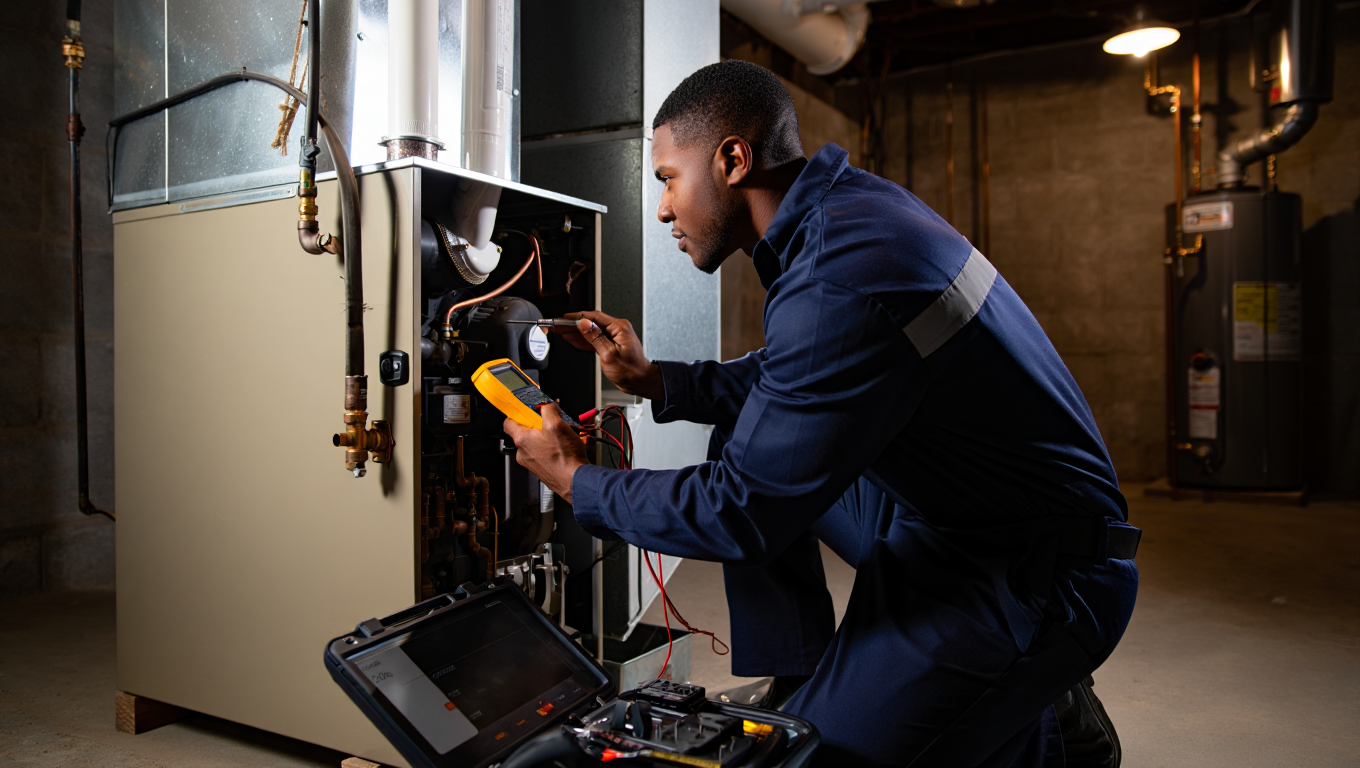
A furnace turning on and off every few minutes, before it ever finishes heating your home, is almost never a coincidence. It is a mechanical pattern called short cycling, and it usually traces back to one of a handful of causes: a dirty filter, blocked airflow, a furnace that is too large for the home, or a failing safety component inside the cabinet.
Short cycling happens when the system shuts itself down before completing a full heating cycle, often as a safety response to overheating or a faulty sensor reading. Some causes are simple enough to check yourself in a few minutes. Others point to a problem that should be looked at by a technician before it turns into a bigger repair, or a safety issue. Here is what typically causes the problem, which checks are safe to run on your own, and when it makes sense to call in a professional.
Common Causes of a Furnace Turning On and Off Too Often
A healthy furnace runs in full cycles. It fires up, pushes warm air through the ductwork until the thermostat reads the target temperature, and then shuts down cleanly. Depending on the outside temperature and how well a home holds heat, that cycle typically lasts ten to twenty minutes. Short cycling collapses that process. The system runs for roughly three to five minutes, shuts off before the house reaches temperature, and restarts almost immediately, similar to a car that stalls every time it pulls out of a driveway.
What a Furnace Turning On and Off Every Few Minutes Means
The pattern shows up in a few noticeable ways. Rooms closest to the furnace, or at the end of short duct runs, stay cold. The system sounds like it is running constantly, yet the house never feels comfortable. The thermostat keeps calling for heat because the furnace never satisfies the demand before shutting down again. If that sounds familiar, short cycling is the likely explanation, and a few basic checks can usually confirm it.
Most of the time, the underlying cause falls into one of these categories:
- Restricted airflow, most often from a dirty filter, closed vents, or a blocked exterior exhaust pipe
- An oversized furnace that heats the living space too quickly and shuts off before distributing heat evenly
- A failing flame sensor that can no longer confirm a flame is present
- A degrading high-limit switch that trips at normal operating temperatures
- A thermostat placed too close to a heat source, causing it to read a falsely warm temperature
Why Restricted Airflow Causes Short Cycling
A furnace depends on a steady supply of cool return air to keep its heat exchanger within a safe operating temperature. When that airflow is restricted for any reason, heat builds up inside the cabinet faster than the system can manage. The high-limit switch, a safety device meant to prevent a cracked heat exchanger or fire, detects that spike and shuts the burner down. Once the unit cools slightly, it restarts, overheats again, and shuts down once more. That loop continues until the restriction is corrected.
Dirty Filters and Blocked Vents
A dirty filter is the single most common trigger. A filter packed with dust, pet dander, and debris acts like a wall across the return air path, starving the furnace of the airflow it needs to run a full cycle. Replacing it costs a few dollars and takes about two minutes, but only if it is caught before repeated overheating trips the limit switch into a fault state that requires a manual reset.
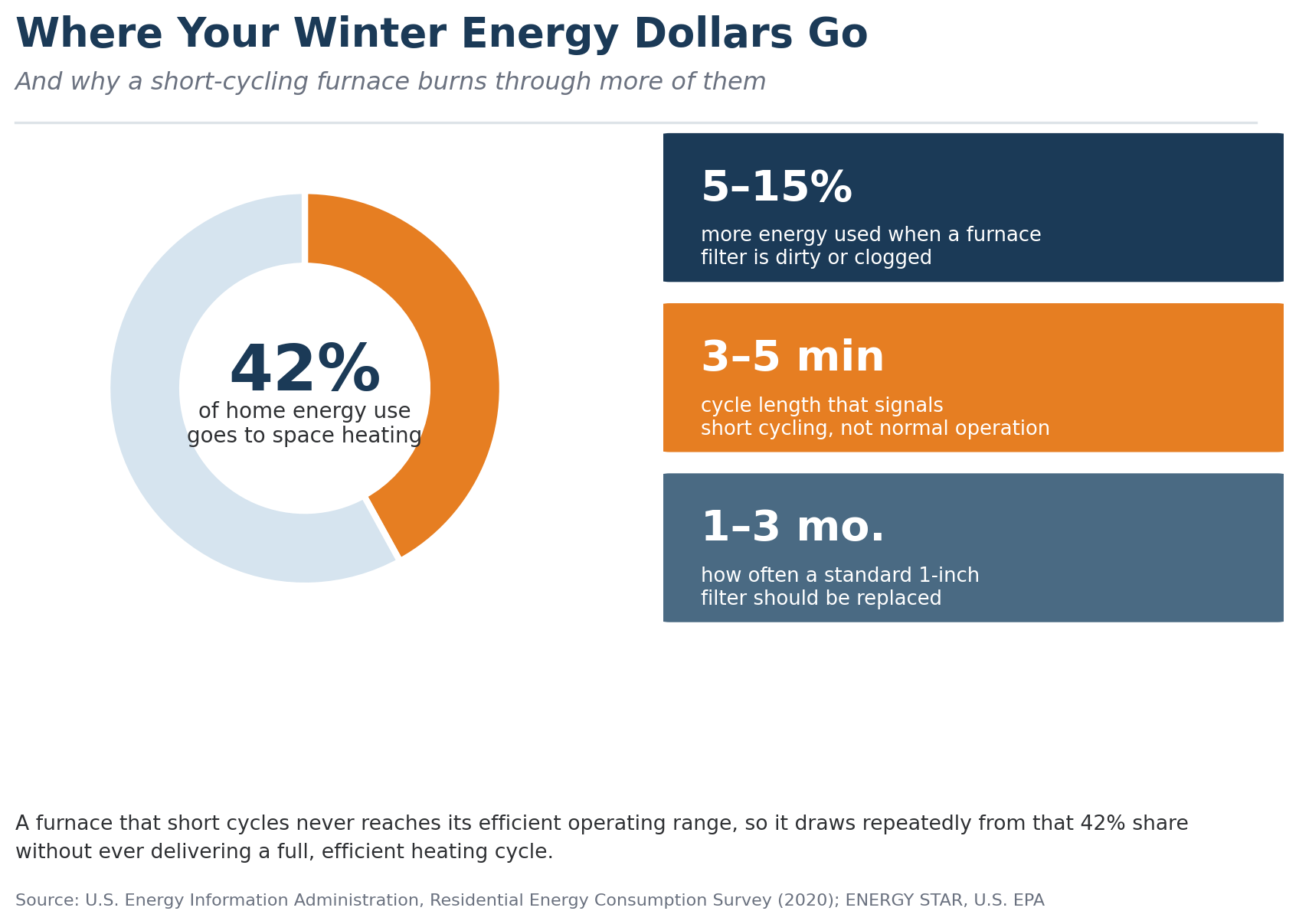
According to the U.S. Department of Energy and ENERGY STAR, nearly half of the energy used in a typical home goes toward heating and cooling, and a dirty filter forces that system to work harder without heating the home any faster. Separately, the U.S. Energy Information Administration reports that space heating alone accounts for 42 percent of energy consumption in the average American home. A furnace that short cycles never reaches its efficient operating range, so it draws repeatedly from that share without ever completing a full, efficient heating cycle.
These checks are worth running before calling anyone:
- Check the air filter. Hold it up to a light source. If light cannot pass through the media, replace it. Standard 1-inch filters generally need replacing every one to three months, sooner if there are pets in the home.
- Walk through every room. Confirm that most supply registers and return grilles are open and unobstructed. Furniture pushed against a vent or a rug covering a floor register can restrict enough airflow to trigger the problem.
- Inspect exterior intake and exhaust pipes. On high-efficiency furnaces with PVC vent pipes exiting through an exterior wall, confirm both pipes are clear of snow, ice, or debris. A blocked exhaust pipe can shut a system down within seconds of startup.
- Check the thermostat’s location. A thermostat mounted near a lamp, a sunny window, or a space heater reads a falsely warm temperature and cuts the furnace off early.
If those checks are clear and the furnace still will not complete a cycle, the cause is likely mechanical rather than airflow-related, and it is time to bring in a technician. Our team offers professional furnace repair with 24/7 availability to diagnose the issue and explain exactly what it will take to fix it.
When an Oversized Furnace Is Behind the Cycling
Bigger is not better when it comes to heating equipment. A furnace sized too large for a home will blast the living space up to temperature in just a few minutes. The thermostat registers the target reading, the furnace shuts off, and the house cools back down quickly because heat was never distributed evenly through the ductwork. The cycle repeats continually, some rooms run warm while others stay cold, and indoor humidity swings because short cycles never run long enough to condition the air properly.
The long-term mechanical picture is worse. Because the furnace never runs long enough to reach its optimal operating temperature, moisture can condense inside the heat exchanger instead of venting out through the flue. Over time, that moisture accelerates rust and corrosion in a component that is expensive to replace. Correcting an oversized system starts with a proper load calculation, an assessment of a home’s actual heating demand based on square footage, insulation, ceiling height, and window area, to determine the output it genuinely needs. Where a full system replacement makes sense, a correctly sized furnace installation resolves the cycling permanently instead of masking it.
Signs an oversized furnace may be driving the problem include:
- The system blasts hot air for only a few minutes before shutting off, leaving some rooms overheated and others still cold
- Heating bills run high despite short run times, because frequent startups consume more energy than fewer, longer cycles would
- The behavior has been present since the system was first installed, rather than developing gradually over time
- Indoor humidity stays uncomfortably high through the winter because short cycles never pull enough moisture out of the air
The Real Cost of Repeated On-and-Off Cycles
Short cycling does not just leave a home cold. It quietly erodes efficiency and equipment life in ways that add up over a full heating season.
- Higher energy bills. Every startup draws a surge of electrical power to ignite the burner and spin the blower motor up to speed. A system starting and stopping dozens of times a day, instead of running fewer, longer cycles, consumes noticeably more energy without delivering proportional heat.
- Uneven temperatures. Warm air needs time to travel through ductwork and reach the rooms farthest from the furnace. Short cycles cut that process off before it finishes, leaving distant rooms colder than the rest of the house.
- Faster wear on components. Each startup and shutdown puts the heat exchanger through a cycle of thermal expansion and contraction. Metal fatigues under repeated stress, and a heat exchanger that should last the life of the system can crack years ahead of schedule.
Many homeowners assume a short-cycling furnace means a full system replacement is unavoidable, but that is usually not the case. Most short-cycling issues resolve with straightforward, affordable repairs such as cleaning a flame sensor, replacing a worn limit switch, or correcting a thermostat wiring issue.
When Furnace Cycling Signals a Safety Problem, Not Just a Comfort Issue
When restricted airflow is not the culprit, the problem almost always lives inside the furnace’s control and safety systems, and that is where DIY troubleshooting reaches its limit.
The flame sensor is a small metal rod that confirms a flame is present after the gas valve opens. When it becomes coated with oxidation or residue, it can no longer read the flame reliably and shuts the system down within seconds as a precaution against unburned gas collecting in the cabinet. Cleaning it takes a technician about fifteen minutes. The high-limit switch is another common failure point. If it is degrading, it may trip at completely normal operating temperatures, cutting the burner off even when nothing is actually overheating.
The most serious scenario is a cracked heat exchanger. Short cycling can both cause and result from this kind of damage. The repeated thermal stress of constant on-and-off cycles weakens the metal, and a crack allows combustion byproducts, including carbon monoxide, to migrate into the living space. Carbon monoxide has no odor and no color, which is exactly why a short-cycling furnace that has been ignored for weeks represents a genuine safety concern rather than just an inconvenience.
The seasonal data on this is worth taking seriously. According to USAFacts, citing data from the Consumer Product Safety Commission and the Centers for Disease Control and Prevention, roughly 84 percent of accidental carbon monoxide poisoning deaths occur between September and April, the exact months furnaces and portable heaters are running. More than 100,000 people visit an emergency room for accidental carbon monoxide poisoning every year, and over 14,000 of those cases require hospitalization.
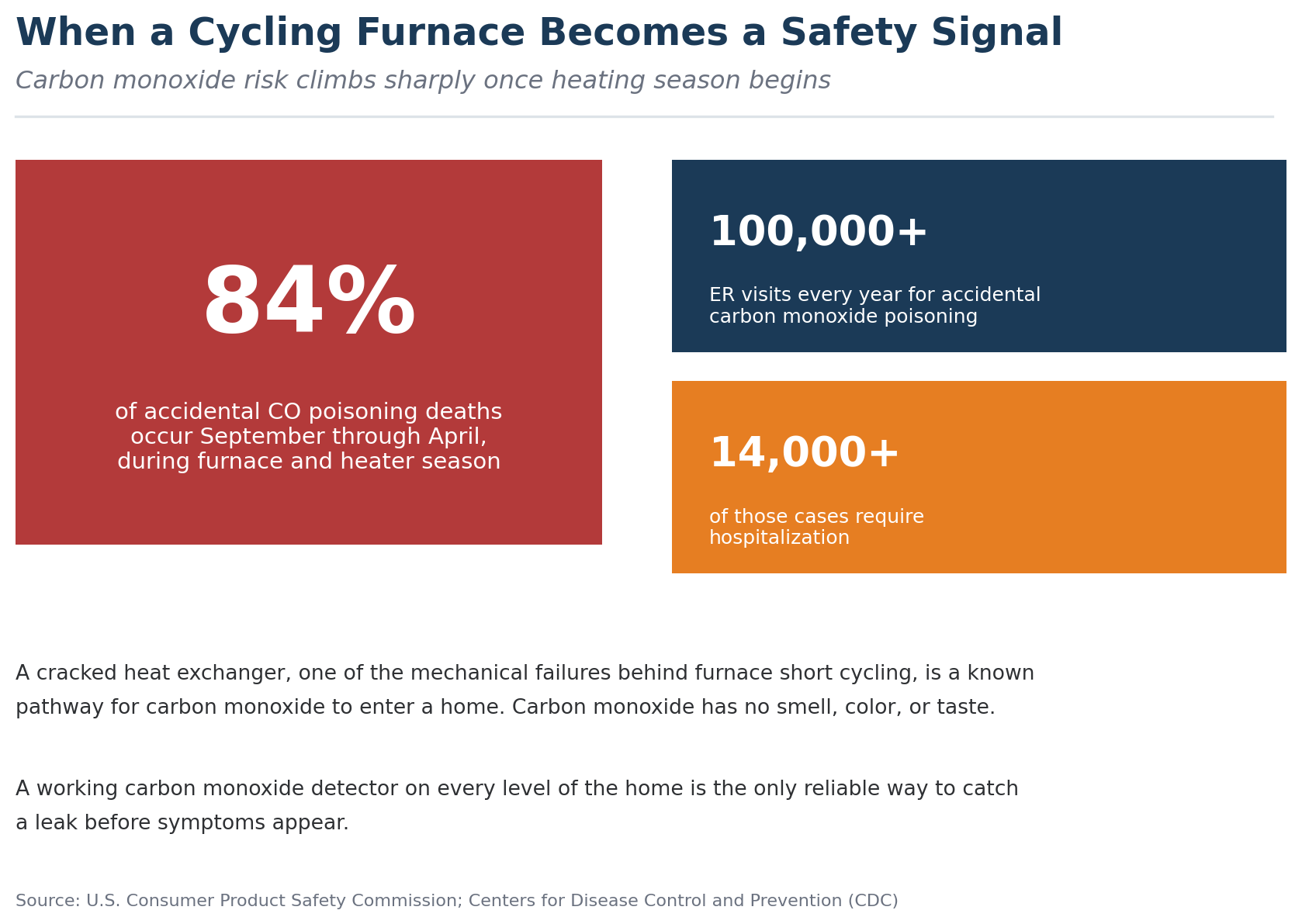
If a furnace has been short cycling for any length of time and there is no working carbon monoxide detector in the home, installing one today is a reasonable precaution, not an overreaction.
Professional Diagnosis and Repair
The good news is that most short-cycling problems are fixable without a full system replacement, provided they get caught before repeated overheating or a safety trip causes lasting damage. A technician will typically test the flame sensor, check the limit switch, inspect the heat exchanger for cracks, and confirm the system is properly sized for the home before recommending a repair. Our team at Schneider Plumbing, Heating and Air Conditioning has been fixing these exact problems since 1948, and we would rather diagnose the actual cause than push an unnecessary replacement.
Whether the fix turns out to be a new filter, a cleaned flame sensor, or a correctly sized replacement system, catching the issue early protects comfort, utility bills, and household safety through the coldest months of the year.
Preventing Short Cycling Before It Starts
A little routine maintenance goes a long way toward keeping a furnace running in full, efficient cycles all winter:
- Check the filter monthly and replace it on schedule, sooner if pets or heavy dust are a factor
- Keep supply registers and return grilles clear of furniture, rugs, and drapes
- Clear snow, ice, and debris away from exterior intake and exhaust pipes after every storm
- Schedule an annual professional tune-up before the coldest months arrive, ideally in the fall
- Install a carbon monoxide detector on every level of the home and test it twice a year
A thorough seasonal furnace tune-up covers all of the components most likely to cause short cycling, including the flame sensor, limit switch, and heat exchanger, before they turn into a mid-winter breakdown.
Frequently Asked Questions About Furnace Short Cycling
How long should a furnace run before it shuts off?
A normal heating cycle typically lasts ten to twenty minutes, depending on the outside temperature and how well the home retains heat. Short cycling is generally defined as the furnace shutting off in under three to five minutes without completing that process. It is a practical diagnostic baseline rather than a strict industry rule, but consistent shutoffs well under five minutes usually point to a real problem.
Should I turn off my furnace if it keeps short cycling?
Yes. Shutting the system down at the thermostat or the breaker while waiting for a technician is the right call. A furnace that is repeatedly overheating or tripping a safety control can sustain further damage to the heat exchanger and blower motor if it keeps running, so limiting that exposure is worthwhile.
What is the most common cause of a furnace turning on and off repeatedly?
A dirty filter. When the filter is clogged, return airflow drops, the heat exchanger overheats quickly, and the high-limit safety switch shuts the burner down to prevent damage. It is the first thing worth checking, since replacing a filter costs far less than the repairs that can follow if it goes unnoticed.
Is a short cycling furnace dangerous?
The short cycling itself is a safety mechanism doing exactly what it is designed to do, but the conditions that trigger it can be genuinely hazardous. Restricted airflow sustained over time can crack a heat exchanger, creating a pathway for carbon monoxide to enter the living space. Getting a cycling furnace diagnosed promptly is about household safety, not just comfort.
Will an annual tune-up prevent short cycling?
In most cases, yes. A seasonal tune-up catches the small issues, a dirty flame sensor, a degrading limit switch, a filter overdue for replacement, before they cause the furnace to shut down mid-cycle. It is the most reliable way to keep a system running in full, efficient cycles through an entire winter.
Get a Cycling Furnace Fixed Before It Gets Worse
A furnace that will not finish a full heating cycle is telling you something is wrong, and the longer that signal goes unanswered, the more expensive the fix tends to become. Schneider Plumbing, Heating and Air Conditioning has been a family-owned business since 1948, now serving its third generation of customers, and we would rather give a straight answer and fix the actual problem than sell an upgrade nobody needs.
If your furnace keeps turning on and off, get in touch with our team to schedule a diagnosis before a simple fix turns into a bigger repair.